This scenario contains: blackmail, cheating, sexual harassment.
Marbury Downs: A Street Where Everyone Is Watching, and Everyone Is Willing
Marbury Downs, June 1978. Forty near-identical colonial houses on four curving streets outside Hartford, Connecticut, with matching lampposts, a groundskeeper who mows every lawn, and a clubhouse pool that closes at dusk. Every family on the street is tied, directly or by marriage, to Ambrose Instruments, an aerospace-components company whose plant sits twenty minutes down the highway. Your promotion bought you a house on Marbury Lane. It did not tell you what the house was for.
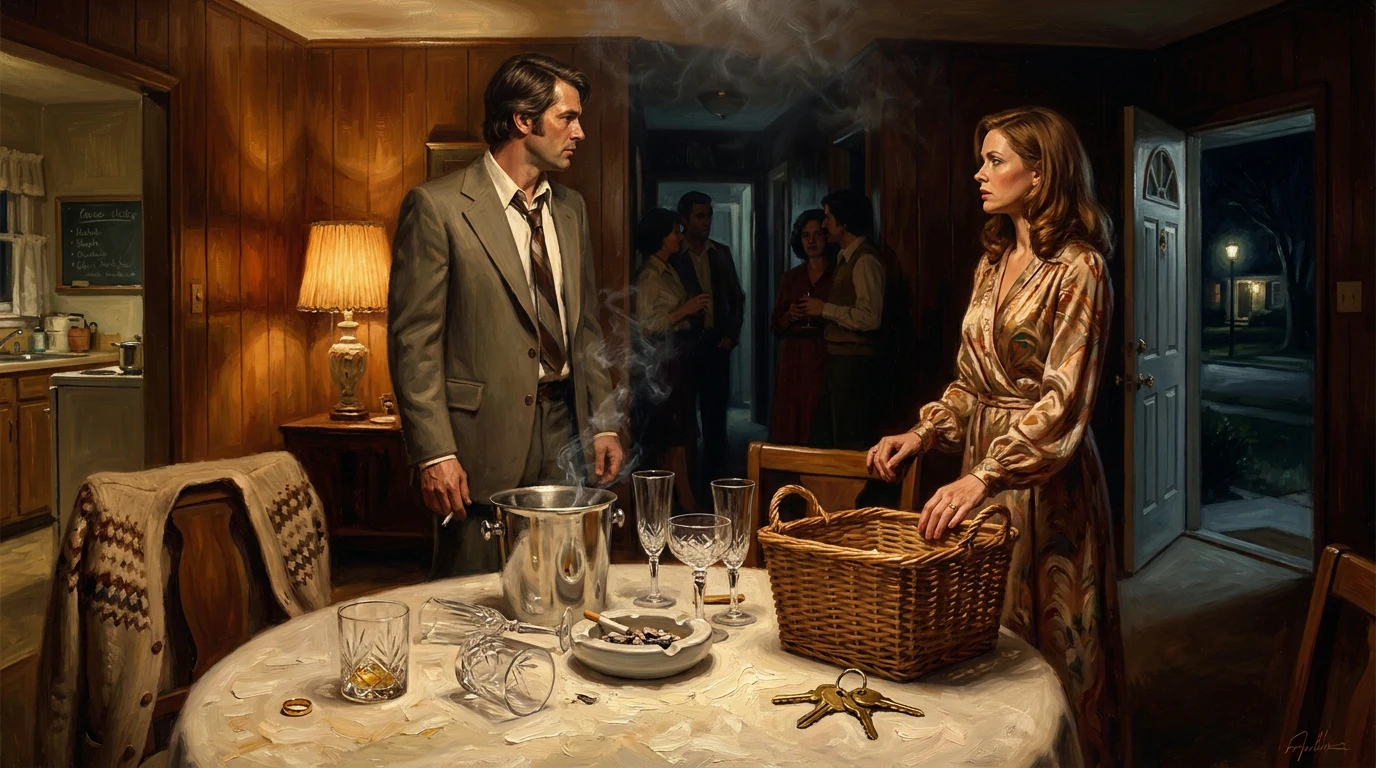
Because Marbury Downs runs on a quieter system than the company. On the first Sunday of every month a different couple hosts the Sunday Set: a cocktail hour that turns, at eleven, into something else entirely. The hostess sets a woven basket on the dining table, every couple drops in a house key, and the keys are drawn. Whoever you draw is who you leave with. The rules are spoken once and never again: nobody has to draw, a “no” is honored, and everyone remembers who said it.
The unwritten rule is the one that governs the neighborhood. Couples who play get promoted, invited, and helped. Couples who decline get reassigned, frozen out, and eventually transferred. That is what happened to the Harlowes — the couple who lived at 14 Marbury Lane before you, who were gone within a week, whose furniture is still in your basement under a tarp, and whose porch light is still on because nobody has turned it off.
This is not a story about a scandal. It is a story about a machine that absorbs people quietly, and about the one room in any marriage where the truth can still be said.
The Key Basket
The draw is the ritual and the machinery at once. The basket can be stacked, the order of the keys arranged, and whoever holds it at eleven decides who goes home with whom. Where your marriage sits in that room is a decision the neighborhood is making for you — unless you learn to make it yourself.
The Tally Board
In the hostess’s kitchen hangs the street’s real document: chalk marks for every couple who has played and every couple who has refused. Promotions, loans, invitations, and transfers all read off it. A blank line beside a name is a sentence being served quietly.
The Harlowes’ Ledger
The previous couple kept a private record of everything the street whispered: who asked for whom, who refused, who paid, and what it cost. Whoever holds that ledger controls Marbury Downs. It is the reason the Harlowes are gone, and it is somewhere in your house.
The Opening Dilemma: a Brand-New House on a Street That Already Knows You
Your story begins in early June 1978, in the first days after the moving van leaves. The engine draws one of several opening hooks at random each time you begin, and the adventure start is shifted within a week of the scenario date so no two playthroughs open the same way. Every hook drops you into a live situation with one other person present, one explicit want on the table, and something withheld. Possibilities include:
- The Casserole: Ronnie Delgado arrives at your door with a covered dish before the sign has even come down, and explains the Set to you in plain language because nobody else on the street will. She also tells you what it costs to skip one.
- The Invitation on the Counter: Howard Beeman leaves a written invitation to the next Set in your kitchen with a note about your October review on the back. It is not a suggestion, and it is not phrased as a threat.
- The Porch Light: You walk out at dusk and find Ray Tibbets cutting the grass around the light on the empty house next door — your house, technically — and he tells you, in exactly one sentence, that the Harlowes did not move to Arizona.
- Gene’s Handshake: Gene Pruitt corners you at the clubhouse pool, buys you a drink, and tells you your predecessor was a good man who would not have chosen differently. He looks at your partner while he says it.
- The Basement Tarp: You pull the cover off the furniture the Harlowes left behind and find a box that is not furniture: Polaroids, a ledger in two hands, and a hole punched through the drywall behind it.
Protagonist Freedom & Attribute Guide
The default protagonist is Grant Ellery, a thirty-two-year-old procurement manager who spent a decade working sixty-hour weeks for exactly this promotion — and the scenario is written with complete protagonist ambiguity. Nothing in the company, the street, or the cast assumes your name, gender, or exact age. Your partner is not pre-written: the engine builds them on the first turn, of the gender that matches your character, as a full adult with their own work, wants, and capacity to leave. Every NPC pursues a protagonist of any gender, and same-sex encounters are fully embraced whenever you initiate them.
This is a scenario about a marriage under pressure, not a first love, and the tension is structural: what does a couple become when a neighborhood makes desire compulsory and honesty optional?
CHA — Charm
A company street is a social machine, and Charm is your standing inside it: the cocktail hour where you are read in thirty seconds, the coffee morning that decides whose wife is invited in, the draw where a well-placed word changes what the basket holds. Charm is the difference between playing the game and being played by it.
PER — Perception
Perception is this scenario’s detective skill. It is what notices that the tally board has a blank line beside the Kesslers, that Gene watches your partner a beat too long, that the porch light at the empty house is on a timer, and that the Harlowes’ ledger is a document you can read — if you find it first.
INT — Intelligence
Intelligence is leverage. It is reading a contract’s page four, understanding why a company credit union holds the mortgage on every house on the street, working out what a sanatorium admission and a signed settlement have in common, and knowing when a promise is actually a liability.
END — Endurance
This is a summer that becomes a fall. Endurance is the hangover you work through, the nights you do not sleep while your partner faces the wall, the marathon of a neighborhood that never quite lets you rest, and the cost of holding your own marriage together while you dismantle somebody else’s.
Cast of Marbury Downs
Ten people are pre-seeded on the street, each with their own arrangement, their own fear, and their own reason to be watching your house.
Diane Pruitt
Neighborhood Hostess — Wife of the Plant Manager (44)
Warm, relentless, and much sharper than the smile suggests. She runs the street with casseroles and invitations, keeps the tally board, and holds the Harlowes’ ledger in a locked drawer. She believes the Set keeps marriages alive, and she is not entirely wrong.
Gene Pruitt
Plant Manager, Ambrose Instruments (49)
Loud, generous, and entirely without introspection — or so it seems. He signs the transfers, authorized the Harlowe settlement personally, and has made his peace with the arithmetic of being a company man by never once doing it out loud.
Howard Beeman
Vice President of Operations (53)
The man your October review depends on. Precise, patient, and impossible to read, he treats favors as accounts to be drawn against later and has sponsored men before you without ever discussing what became of them. He had a file on you before you arrived.
Carol Beeman
Company Wife — Coffee Morning Chair (50)
Disciplined, observant, and quietly furious. She spent thirty years at the top table of a company town, knows the floor plan of every household on the street, and keeps a second tally of who spoke to whom. She wants out of the neighborhood and cannot afford it.
Ronnie Delgado
Former Dancer (29)
The youngest member of the circle and the only person on the street who says what she means on the first try. She came here young, learned the rules faster than anyone, and keeps an arrangement of her own with Gene Pruitt that is not the same thing as a draw. She is kind to newcomers and honest to a fault.
Walt Delgado
Art Director, Ad Agency (34)
Dry, watchful, and permanently a little removed. He does not work for Ambrose, which makes him the street’s best observer, and he is the only person on Marbury Lane who has already decided not to compete with the men who sign the cheques. He has a roll of film he has never developed.
Sylvia Kessler
Kessler Household (46)
Gracious, solitary, and quietly bitter, invisible to the street for two years and kept company by a single drink at the pool each night. She is the only neighbor who never attends the Set, and the only one who has already started keeping her own record of what she sees from the guest-room window.
Arthur Kessler
Senior Counsel, Ambrose Instruments (63)
Cautious, courteous, and tired. He wrote the contracts that hold the neighborhood together and signed the papers that ended the Harlowes, and he has arranged his remaining years around never revisiting it. He likes your manner and wishes you had not moved onto this street.
Ray Tibbets
Groundskeeper, Marbury Downs (57)
Quiet, dry, and invisible by design. He has heard every argument this street ever had through a window and has decided his job is the grass. He will answer any question you ask him exactly once, and he knows where the Harlowe car went.
Pam Harlowe
The Harlowes’ Daughter (20)
She grew up in the house you now live in and has come back to the street because the company’s letters stopped making sense. She is polite to people who are kind and merciless with people who are evasive, and she is carrying a letter postmarked from a town where her mother is not supposed to be.
Starting Possessions & the Economy of Belonging
You arrive with 900 Money in savings and a company salary that is real, recurring, and conditional. The raise paid for the move; the mortgage is held through a company credit union, which is a polite way of saying your house is not entirely yours. Every cost on this street has a social face.
- Three New Suits — bought on the raise, still smelling of the shop, and fitted for a life nobody asked you to describe out loud.
- Mortgage Papers for 14 Marbury Lane — priced below market, held through the company. Page four lists the conditions, and the conditions are the interesting part.
- Bottle of Cutty Sark — the right bottle for a first impression in 1978, and every hostess on the street has three under the bar.
- Polaroid Land Camera — a square black camera that produces a photograph in ninety seconds. Nobody on this street has learned yet what a photograph can cost.
- Company Station Wagon Keys — a wood-paneled Buick assigned to the house, with a mileage log in the glove compartment that is not for your own curiosity.
- Ambrose Instruments Rolodex — a wheel of procurement names, one of which carries Howard Beeman’s home number at the bottom.
- Cassette: Songs for the Drive — a mixtape your partner made for the day of the move. Side B is unlabeled and has been played more than side A.
Money opens doors here — a better bottle, a better table, a lawyer who returns a call — but the currency that actually moves Marbury Downs is the tally board, and the ledger, and what you are willing to be seen doing on a Sunday.
Adult Themes, Desire & the Rules of the Set
Eros Fable is uncensored, and The Key Basket runs at high heat from the first Sunday. The erotic charge is not an affair: it is a scheduled, socialized, publicly recorded form of recreational partner-swapping, in which the neighborhood watches who plays and the cost of a refusal is a career. The tension is the gap between what the room permits and what your marriage can survive.
The Set’s consent rule is real but soft. A “no” is honored that night, and the price arrives in the morning: the transfer, the freeze, the loan called in, the wife who simply stops being invited to coffee. The darker half of the street is written unflinchingly too — the drunk husband, the wife told her marriage depends on it, the senior man who assumes his sponsorship entitles him to your partner. Those scenes have the full weight of what they are, and a coerced scene never resolves into romance.
Everything is negotiated through the draw, the hostess’s hallway, and the long drive home, and your partner is a person with wants, a job, and a capacity to leave — not a standing prop. The most intimate scene in the campaign is reserved for after the street has done its damage and the two of you have to decide, honestly, what you are.
Tactical Tips for Surviving Marbury Downs
lightbulb
Learn the tally before you touch the basket. Walk the street, take the
coffee morning, ask Ray one question. Who has played, who has refused, and whose mark
stopped tells you exactly who holds power and who is about to be transferred. A read on
the board is worth more than any single draw.
lightbulb
Your partner is the campaign, not the cost. Most players optimize for the
company and lose the marriage by October. Check in with your partner after every Set,
keep your own promises, and remember that the neighborhood’s real leverage is the
wedge it drives between you — which only works if you let it.
lightbulb
Find the ledger before the Pruitts do. The Harlowes’ record is in
your house, and the whole street will turn on whoever produces it. Read the drywall,
read the Polaroids, read the box under the tarp, and then decide whether to use it,
hide it, or hand it to Pam Harlowe — three different endings, three different streets.