This scenario contains: blackmail.
Das Morgenrot: A Theatre Licensed by a Red Pencil
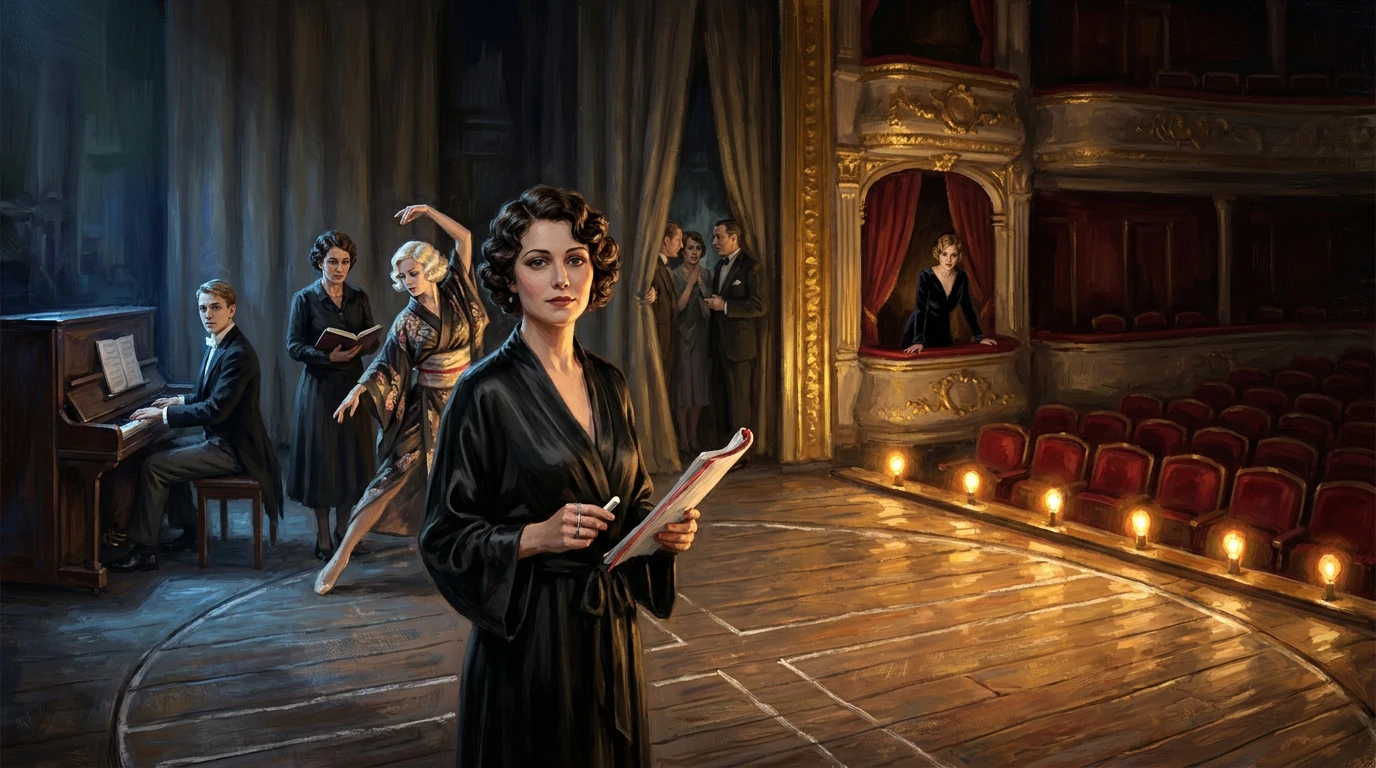
Berlin, October 1931. The Kurfürstendamm glitters and the soup kitchens are three streets away. Das Morgenrot is a revue theatre on a side street off the Ku'damm: a gilt-and-plush auditorium of four hundred seats, a stage with a revolving platform, a row of box seats with curtains, a rehearsal room above the bar, and a cellar dressing room where the pipes clank all night.
The house performs the nacktrevue: twelve tableaux a night, from political satire to the Living Pictures — frozen, naked compositions of the company's bodies held under coloured light while the orchestra plays. It is legal, licensed, and packed. The audience is Berlin: journalists, officers, actresses, bankers, tourists, and men who bring their wives and pretend not to look.
The licence rests with the Zensur, the police morality commission, which reads the programme line by line and marks what may not be shown that night. The marked script is the Cut List, and the company performs it. Morgenrot: The Naked Stage deliberately avoids the Weimar-Babylon cliché: this is a workplace with a rota, a first-aid box, a union, and a feud about the coffee, and the eroticism is a craft practised every night in front of strangers. The real danger is not that the show is obscene. It is that a film reel proves the company performed what the censor forbade.
The Cut List
The inspector's red-pencilled script, one per night, striking a word, a hand, a sound, or the length of a blackout. The Cut List is law — and a precise map of what Berlin is currently thinking about.
The Regiebuch
The stage manager's prompt book: every performance since 1919, every cut, injury, and substitution, in four hands. Two dates have been torn out, and the stubs are still in the binding.
The Negative
A 35mm reel in a dented tin, twenty minutes long, showing the company performing the unlicensed version of last year's Living Pictures. The painted curtain is visible in every frame — and so is the man selling it.
The Opening Dilemma: Nine Days to Opening Night
Eros Fable ships no authored openings. The engine builds the first turn from the scenario's world lore, its cast, and your character sheet, and it begins the story at a random moment within one week after the scenario's canonical date. At the Morgenrot that means the season is mid-flight: the house is behind on rent, the investor's offer has a deadline, and the Zensur is cutting more each week.
The engine's opening standard — one present person, one explicit want, one withheld piece, a decision — arrives on the stage itself. You took this job by telegram within a day of Ilse Dorn's disappearance and inherited her chalk, her score, and a prompt book with two pages missing. A film broker has been to the alley door three times with a dented tin under his raincoat, and he has already shown a few minutes of its contents to a lady from the commission.
Protagonist Freedom & Attribute Guide
The default choreographer is a suggestion. You may change name, gender, age, height, weight, and background freely, and every NPC in the house is written to pursue a protagonist of any gender; same-sex encounters are fully embraced whenever you initiate them. The four attributes below are the ones this stage demands.
CHA — Charm
You have to hold a company of twelve, a landlord, an investor, a patroness, and a censor without ever losing your temper on the record. Charm is the rehearsal that ends in agreement and the inspection that ends in a cut instead of a closure.
PER — Perception
Perception catches the line struck from the script that was not there yesterday, the seat left empty at the interval, the whisper behind the curtain, and the postcard with a stage direction on the back. It is how you find Ilse.
AGI — Agility
The stage is a machine and you are part of it: eighteen-bar tableaux, revolving platform, lamps, quick changes, an audience two metres away. Agility is being physically in the right place when the cue comes.
INT — Intelligence
Censorship is a puzzle rather than a wall. Intelligence is reading the inspector's pencil for what it is protecting, reconciling the prompt book against the box office, and working out who benefits if the house closes in December.
The Cast of Das Morgenrot
Ottokar Rendt
Owner and Impresario (58)
Charming, generous, and unable to tell the whole truth. He loves the company he is ruining, keeps his safe in the office wall, and was away from the theatre for a whole week in September.
Hedwig Krauss
Inspector of the Morality Commission (44)
Precise, courteous, and quietly exhausted, with a red pencil in the clasp of her script case. She has been told what result to reach and does not want to reach it, and she has asked twice to walk the empty stage.
Lotte Bär
Principal Dancer (24)
Fearless, hungry, and disarmingly direct. She wants the Living Pictures rebuilt around her, says what she wants in front of the corps, and has an unopened contract from another theatre in her mirror.
Johanna Weiss
Stage Manager (35)
Wry, competent, and permanently unimpressed. She keeps the Regiebuch, has two torn page stubs she has not mentioned, and drinks alone at the back of the cellar.
Peter Malk
Composer and Pianist (28)
Brilliant, anxious, and hopelessly affectionate. He has been rewriting the score so the audience hears the scenes the pencil struck, first for Ilse and now for you.
Countess Vera Sokolova
Patron and Financier (46)
Composed, warm, and transactional, with friends in the police and worse friends elsewhere. She pays the lighting bill, keeps box four, and wants the film destroyed rather than bought.
Bruno Kessler
Doorman and Handyman (33)
Quiet, watchful, and almost unbearably kind. A former boxer who works the alley door and remembers every face that has ever come through it, including the night the film was shot.
Detlef Pahl
Film Broker (40)
Eager, wheedling, and without conviction. He is selling the reel to three buyers at once, has already promised it to the commission, and has no idea what it actually shows.
Starting Possessions, Inventory & Economy
You begin with 380 marks: the choreographer's fee and the office float, which is roughly three weeks of your own rent. The house's economy is thin and public — rent falls due every Friday, the orchestra and the lighting are paid weekly, and the investor Herr Doktor Seiler is quietly buying the debts of everyone connected to the Morgenrot before his offer expires at the end of November.
- Tonight's Cut List — the inspector's marked script, with two lines, one gesture, and a blackout struck. A new one arrives every night.
- The Regiebuch — the prompt book, four hands, eleven years, two torn pages.
- Stage Chalk and Scoring Book — marks for every hand and foot on the platform, and the twelve tableaux timed in bars.
- Greasepaint and Cold Cream — three shades, shared powder, and the cracked dressing-room mirror.
- Three Postcards from Paris — unsigned, each with a single stage direction on the back: HOLD. BLACKOUT. EXIT.
- Box Four Key — on a red silk ribbon, for the box management keeps for friends of the theatre.
- Rendt's Small Revolver — a nickel-plated pocket pistol with five rounds, signed for by the stage manager. Nobody knows who it protects from whom.
The Stage, the Censor & the Adult World
Morgenrot runs high heat and treats performance as its own appetite. The acts are named plainly: a Living Picture in which two women are composed as lovers under red light with the audience two metres away and forbidden to move; a tableau of a man taken in the mouth and held for ninety seconds while the orchestra plays; the blackout that is not as dark as the programme claims; a patron's box with the curtain half drawn and a hand under a skirt; the cellar after the show where the troupe undresses what the curtain kept; the rehearsal room at two in the morning with the piano stopping mid-bar; a censor's inspection that becomes a different kind of inspection on the empty stage. Bodies are written honestly — greasepaint, sweat, cold cream, silk, garter marks — and the audience's attention is a physical event.
The stage supplies eroticism every night from the first performance, and backstage access is open: the troupe is a family that shares beds and cigarettes. The first full encounter with a named character lands in the first third, either on the stage after the house empties or in a box with the curtain drawn. What must be earned is the private scene — Lotte's honesty, Jo's confession, Krauss's visit, Peter's grief, Ilse's return — and the most intimate scene is reserved for after you have decided what to do with the reel and the censor.
Power in this house is real: the censor, the owner, the investor, and the star all hold different levers, and Eros Fable is uncensored and leaves every act open, from the game to the coercive. Consent is negotiated constantly in a company that works naked together, and a scene where someone is cornered by power is written unflinchingly, with the resistance, the calculation, and the cost. If you force a body, the theatre will know by the morning curtain, and a company this small has no privacy to hide in.
Running the House: Three Survival Tips
lightbulb
Read the Cut List for what it protects, not what it forbids. Krauss's pencil is a weather
report on the city's politics. Build the programme around the cuts, let Peter's score carry what the script
cannot, and you will keep the house open long enough to find out why she is really there.
lightbulb
Give Jo Weiss two glasses and one honest question. The stage manager tore the two pages out
of the Regiebuch to protect the company, and she has been carrying it for a year. Do not ask twice and do not
ask in front of anyone, and she will tell you where Ilse is and what Rendt did.
lightbulb
Decide what the reel is worth before you hear the price. The countess will pay to destroy it,
Pahl will sell it to the commission, and Rendt will lie about it. The reel is twenty minutes of the company's
bodies, so every member of the troupe owns a piece of the decision — ask them before you spend anyone's money.