This scenario contains: blackmail.
The Mouseion of Alexandria: A Library With a Locked Room
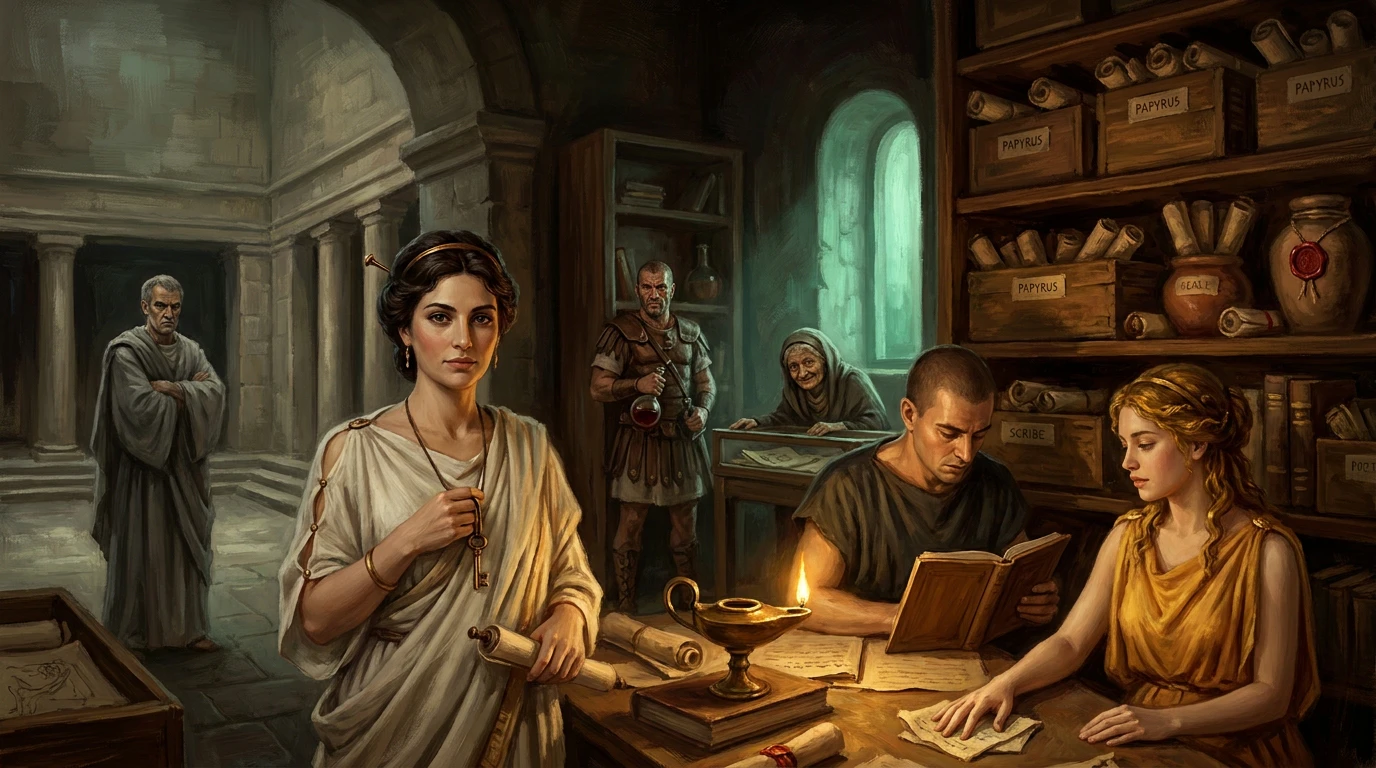
Alexandria, spring 246 BC, in the reign of King Soterion II and Queen Melitta. The city is a grid of white limestone on the Canopic shore: the Brucheion palace quarter, the harbor with the great lighthouse on Pharos, the temple of Isis at the water's edge, and the Mouseion — the royal research institution with its colonnades, lecture halls, gardens, and shelf-rooms where four hundred thousand scrolls are kept.
Your charge is the Casket Room: a small locked chamber off the Anatomists' colonnade where the library keeps what it will not lend. Banned verse, love-magic, drawings of bodies opened, and the poems of Hedea of Mytilene, an Alexandrian court poetess who wrote explicitly about women's bodies and the King's debts until she was poisoned four years ago and her scrolls were banned.
The Mouseion runs on a single document. The Pinakes is the great catalogue: wooden tablets listing every scroll, its author, its provenance, its copies, and every borrower, in the hands of six generations of Keepers. It is the true map of the library and of the court, because it records who read what and when — and which of those readers is now a minister. The Twelfth Volume is a story about a library that is an instrument of power, about an arson that was policy rather than tragedy, and about a banned book that is not what anyone thinks it is.
The Pinakes
The catalogue is the crown's property and the city's memory. Every loan is a political act, every borrower leaves a mark, and erasing an entry is a crime with a signature attached.
The Sealed Jar
A clay jar on a cedar shelf, sealed with the King's own seal and the Keeper's mark, containing one scroll the Keeper may not open. Four Keepers have resisted it. It has been sealed since the fire.
The Burnt Wing
Forty thousand scrolls burned in the Soma four years ago, and the previous Keeper with them, holding the shelf door shut. Scavengers are still selling charred papyrus in the market, and one buyer works for the Queen.
The Opening Dilemma: The Volume That Never Returned
Eros Fable does not ship authored openings. The engine assembles the first turn from the scenario's world lore, its pre-seeded cast, and your character sheet, and it begins the story at a random moment within one week after the scenario's canonical date. In Alexandria that means the court is mid-intrigue: the King's Syrian war is bleeding the treasury, offices are being sold, and the Queen's symposium is coming.
The engine's opening standard — one present person, one explicit want, one withheld piece, a decision — arrives with a hole in the catalogue. The Pinakes shows that the twelfth and last volume of Hedea's banned sequence was borrowed by your predecessor and never returned, and your predecessor died in the Soma fire holding a door shut so that other scrolls could be carried out. Three people in the city know the twelfth volume was never in the library at all.
Protagonist Freedom & Attribute Guide
The default Keeper is a suggestion. You may change name, gender, age, height, weight, and background freely, and every NPC at court is written to pursue a protagonist of any gender; same-sex encounters are fully embraced whenever you initiate them. The four attributes below are the ones the office rewards.
INT — Intelligence
You are a catalogue with a memory. Intelligence is how you date an ink, reconstruct a loan from three borrowers' names, read a poem as an account book, and know which page of the Pinakes was scraped and rewritten.
PER — Perception
Perception catches the guard standing under your window, the fragment sewn into a sash, the wax tablet that has been held too long in a warm hand, and the one sheet in the Anatomists' collection showing a burned body rather than a cut one.
CHA — Charm
The casket is opened on your authority and with a witness, and the witness is usually someone you had to persuade. Charm is how you borrow a warden's key, keep the Queen interested, and make the Chief Librarian underestimate you for one more week.
AGI — Agility
Court is a room full of doors. Agility is the hand that lifts a counterfoil from a palace archive, the nerve to hold a posture while a guard searches the room, and the speed to get a scroll out of the Mouseion before the King's men arrive.
The Cast of the Mouseion
Zenodora
Chief Librarian (52)
Brilliant, punctilious, and permanently aggrieved. She was passed over for your office, corrects your catalogue entries before the ink dries, and is compiling a memorandum about your appointment.
Queen Melitta
Queen of Egypt (34)
Witty, watchful, and unhurried. She appointed you because a new Keeper is easier to use than an old one, has invited you to read at her symposium, and looks at you with an attention that is not entirely about papyrus.
Doris
Scribe of the Casket (27)
Quick, quiet, and the best hand in the room. She lights the lamps before you arrive, has never copied a scroll for anyone else, and asked twice whether the twelfth volume's borrower's entry had been explained.
Kallias
Captain of the Somatophylax (38)
Formal, heavy, and quietly ruined. He signs the permits, does his duty perfectly in daylight, and stands under your window at night with a wine flask and something he cannot say.
Menander
Royal Secretary (45)
Warm, apologetic, and constantly calculating. He reads every royal letter before it is sealed, has offered you three excuses to inventory the casket at court, and has been to the burnt wing twice with his writing case.
Thais
Court Hetaira and Poetess (24)
Quick, funny, and professionally free. She recites at every symposium, quotes Hedea by heart in the middle of a joke, and keeps a folded scrap of papyrus sewn into her sash that she has never explained.
Amaryllis
Keeper of the Anatomists' Collection (60)
Dry, patient, sly, and thirty years in one colonnade. She holds the second key to the cases, answers a direct question only when it is asked the right way, and said something about the fourth case she refused to repeat.
Nikanor
Anatomist and Palace Physician (40)
Precise, cultured, and quietly ruthless. He is the only man in Alexandria who can read a body, and he mentioned the three burned sheets to you and then called it a copying error without looking at you.
Starting Possessions, Inventory & Economy
You begin with 650 Money: the office's stipend, advanced for the quarter, plus whatever your own lectures and copywork earn. Alexandria's economy runs on drachmae, grain, favors, and patronage; the casket's budget is signed off by the Chief Librarian, the palace can claim anything with a word, and a Keeper who allows a banned scroll to be copied is charged with treason.
- The Keeper's Copy of the Pinakes — the casket's share of the catalogue, with one borrower's entry in a dead man's hand.
- The Casket Key — bronze on a plain cord, cut for the double lock. The old one was never found after the fire.
- Wax Tablets and Stylus (x6) — for notes taken on the spot. The wax softens in a warm hand, which has made your notes a subject of court speculation.
- Hedea's Eleven, Sealed — eleven papyrus rolls in cedar boxes, sealed with clay. You are the only person in Alexandria permitted to break these seals.
- The Anatomists' Drawings — a codex of parchment sheets in red ochre, three of which show a body burned rather than cut.
- Keeper's Linen Chiton — fine Milesian linen with deep sleeves that hide a wax tablet.
- Harbor Debt Token — a Rhodian lender's stamped lead token, worth a hundred drachmae and far more as evidence. It was left in the casket's door frame, not its lock.
Verse, Power & the Adult World
The Twelfth Volume runs high heat and puts the reading voice at the center of it. The acts are named plainly: reading Hedea aloud to a woman on a couch while the poem does its work; fingers under a chiton in a colonnade with a lamp guttering; a symposium's after-party in the garden where the hetairai and the scholars pair off and the wine decides who is on top; the Queen's particular appetite for a woman who reads well, taken on the royal couch while the guard pretends not to hear; two scribes on a copyist's table with the ink still wet; a mouth between thighs while the papyrus crinkles under a shoulder. The poetry is written as arousal, not decoration.
Erotic reading and touch are available from the first week: the Mouseion is a bright, tactile, poorly supervised place, and the casket room has a lock you hold. The first full encounter lands in the first third — at the Queen's symposium or with Doris in the archive — and it must change what you are willing to write down. What must be earned is the mutual scene: Thais's fragment, the Queen's real confidence, Doris's grandfather-name, Nikanor's confession. The most intimate scene is held until you have read the twelfth volume and know what it costs.
Alexandria is a city of unequal beds, and the scenario does not pretend otherwise. Slaves, hetairai, wards, and servants cannot always say no, and the player's own position in the Queen's bed is a bargained position rather than a safe one. Eros Fable is uncensored: every act is open to the player, from the courtly to the coercive, and the household will know by morning.
Keeping the Casket: Three Survival Tips
lightbulb
Open the sealed jar before the King's auditors ask about it. Every Keeper before you resisted,
and the jar has been sealed since the fire. Whatever is inside is the reason the seal exists, and the day the
casket is inventoried is the day the seal becomes a question with your name on it.
lightbulb
Buy Amaryllis a stool and ask her the right way. The Anatomists' keeper has been guarding one
item for four years and will tell you where it sits the moment you ask the question in the words she has been
waiting to hear. Brute force gets you a locked case and a woman who has already forgotten your name.
lightbulb
Let the Queen believe she is using you for a while. Melitta appointed you because a new
Keeper is easier to use, and the only real leverage you have is that she also enjoys the conversation. Trade
her a reading for an afternoon of access, and keep the ledger's names for yourself until you know whose hands
you want them in.