This scenario contains: blackmail, rape.
Ravenscote: A House That Writes Down Every Stroke
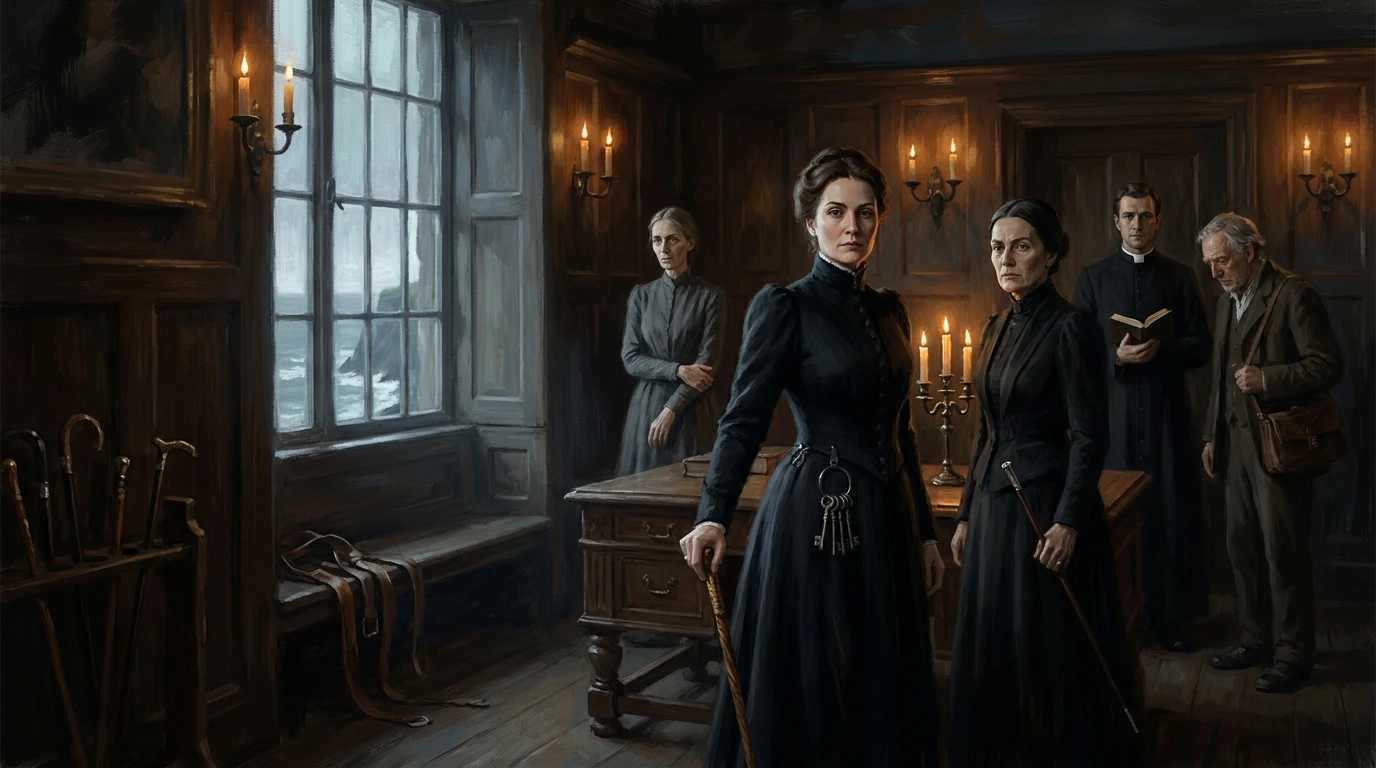
Cornwall, September 1901. Ravenscote is a granite house on the cliffs above Morvath Cove, four hours by trap from Penzance: forty rooms, a walled garden, a coal-fired boiler, and the sea audible in every corridor. It keeps twelve to twenty wards at a time — adults of good family, eighteen to thirty-five, sent by their relatives to be corrected. Hysteria, debts, defiance, disgrace: the kind of behaviour a family will pay to have cured quietly, far from London.
The house runs on the Correction Hours: morning inspection, lessons, labour, discipline at four, evening prayers, lock-up at nine. Discipline is corporal, formal, and unvarying — corner time, restraint, the birch soaking in the scullery tub, the cane, the strap, and, for graver offences, the withholding of privileges, comforts, and company.
And it runs on paper. A framed charter hangs in the hall, read aloud to every ward on arrival: correction only by the Directress or her deputy; every punishment entered in the Caning Book with the ward's name, the offence, the instrument, the count, and two signatures; the physician must certify fitness first; nothing in anger, nothing in the night, nothing without a witness. The charter names many rooms. It does not, anywhere, name the Quiet Room.
The Caning Book
A leather ledger, one page per ward per quarter, every punishment in the Directress's hand. Most pages carry two signatures. Some carry three — the Directress's, the ward's, and a firm upright hand that belongs to no one at Ravenscote.
The Quiet Room
A whitewashed chamber at the end of the west corridor with a barred window over the sea and a bench. No entry in the Book has ever named it. Its door has a new lock, and its far wall hides a second door.
The Third Signature
The wards on those pages are always held past the terms of their family contracts. The hand is London's — the patron's solicitor arrives quarterly with the contracts, the transfer list, and no interest in explanations.
The Opening Dilemma: You Were a Ward Here Once
Eros Fable ships no authored openings. The engine builds the first turn from the scenario's world lore, its cast, and your character sheet, and it starts the adventure at a random moment within one week after the scenario's canonical date. At Ravenscote that means the quarter is in progress: the wards are restless, the physician is drinking, and the patron's quarterly visit is close.
The engine's opening standard — one present person, one explicit want, one withheld piece, a decision — arrives with history attached here. You took the office after writing to the patron and asking for it, and the reason you asked is that nine years ago you signed the admission book as a ward and spent fourteen months on the same bench. You know how this house feels from the inside. You also know, now, that some pages of the Book carry a third signature and that a room at the end of the west corridor has no page at all.
Protagonist Freedom & Attribute Guide
The default Directress is a suggestion. You can change name, gender, age, height, weight, and background freely, and every NPC at Ravenscote is written to pursue a protagonist of any gender; same-sex encounters are fully embraced whenever you initiate them. The four attributes below are the ones the office demands.
CHA — Charm
The office is authority performed calmly. Charm is how you hold a room of wards, keep the under-directress in her lane, disarm a solicitor with a cup of tea, and make a punishment feel like order rather than appetite.
INT — Intelligence
The Book is twelve years of entries and the house's only defense. Intelligence is how you read a page for what it leaves out, date a certificate, reconcile the infirmary ledger with the register, and know which ink is younger than the paper.
PER — Perception
Perception catches the ward who is frightened rather than defiant, the chaplain who knows more than he says, the key in the tea caddy, and the sea-stained dress in the passage. It is the attribute that keeps you from becoming your predecessor.
STR — Strength
This is a house of physical discipline, and the cane is only one instrument. Strength is holding a ward steady on the bench, carrying the coal, and being physically unafraid in a place where fear is a currency.
The Cast of Ravenscote
Mrs. Letitia Vane
Housekeeper (56)
Brusque and exact, with keys that make no sound and ears that miss nothing. She burns the wards' letters so they cannot be used against them and keeps the tea caddy locked.
Mr. Ambrose Crick
The Patron's Solicitor (48)
Precise, courteous, and untroubled: he speaks of confinement in terms of arrangements and of wards in terms of cases. He carries a second list he does not offer to show you.
Clara Pell
Ward, Hysteria (22)
Angry, brilliant, and unafraid of consequences. She refuses to sign the admission of fault that every privilege depends on, keeps her own ledger in cipher, and has noticed the third signature.
Thomas Ashgate
Ward, Debts (26)
Charming, calculating, and frightened under it. He asks for the cane in front of the others, wears the marks like a medal, and will sign anything to keep from going to a debtors' prison.
Agnes Rowe
Ward, Insubordination (31)
A governess who asked to come, signed her own admission in a steady hand, and keeps the charter folded in her sleeve. She brought you the third signature and hopes the answer is what she believes.
Dr. Ephraim Sallow
Physician (60)
Learned, gentle, and finished. He certifies every punishment and may suspend any of them at his sole discretion, and he has been drinking in the infirmary since 1899 because of what he signed.
Father Ives
Chaplain (44)
Severe in the chapel and unexpectedly practical everywhere else: he mends the wards' clothes, hides their letters, and hears every confession in the house without ever repeating one.
Miss Prudence Wexley
Under-Directress (30)
Competent, ambitious, and brittle. She ran the house between Directresses, corrects harder than the charter requires, and has written to Mr. Crick about the office.
Starting Possessions, Inventory & Economy
You begin with 220 Money: your own small savings, the house's petty cash, and the difference between the two, which the housekeeper will expect you to keep straight. Ravenscote is funded by the wards' families at a quarterly rate, and the patron takes his share in London. The economy that matters here is favors, signatures, and information: the physician's certificate, the chaplain's silence, the solicitor's list.
- The Caning Book — the office and the alibi: every punishment, every count, two signatures, and occasionally three.
- The Directress's Chatelaine — nine iron keys, including one small key nobody has explained to you.
- The Senior Cane — pale rattan in oiled cloth, re-tipped twice, named in the charter itself.
- Birch Bundles, Scullery Tub (x4) — bound with twine, changed every third day. The wards fear the birch more than the cane.
- Bench Straps and Shackles — wide leather for wrists, ankles, and waist, oiled, mended, and functional. Nothing ornamental.
- Arnica and Cold Cream (x2) — aftercare required by the house rules and recorded, with the hour, in the Book.
- Unopened Letter, Bodmin Postmark — addressed to the Directress in a woman's hand, opened once before you and resealed with different wax.
Discipline, Coercion & the Adult World
The Rule of Ravenscote runs high heat and does not soften what it is. The acts are named plainly: the cane across a bare backside with the count read aloud; the birch dripping on the flagstones; a ward bent over the bench with wrists strapped and skirts up; corner time naked and watched; a stiff cock taken in hand or mouth as correction or service; a Directress's fingers between a ward's legs to test obedience; two wards made to serve each other while the room watches; orgasm withheld for weeks and then granted as a privilege. Aftercare is salve, water, blankets, and a note in the Book.
The first full sexual correction lands in the first third. What must be earned is the private, mutual encounter — the ward who asks, the servant who offers, the physician who confesses — each unlocked by a kindness you did not have to give, a punishment you refused to record, or a secret you kept.
The wards of Ravenscote are legal adults and not free adults: they are confined, their families have paid, and they cannot leave. The scenario names that coercion rather than laundering it, and lets each ward answer it in their own way — resistance, bargaining, appetite, surrender, calculation, or love. Consent is formally logged in the Book and materially constrained, and a scene where the player ignores a ward's no is permitted by this world and written unflinchingly. Every adult theme in Eros Fable is uncensored and open; nothing is faded to black.
Running the House: Three Survival Tips
lightbulb
Never write a line that did not happen, and never leave out one that did. The Book is both
your law and your alibi, and it is auditable by families, the visitor, and the patron. The moment the register
and a ward's body disagree, the under-directress has your office.
lightbulb
Own the physician. Sallow is the only person who can stop a punishment you have already
ordered, and he will sign anything if you do not look at him while he does it. Keep him sober enough to write
legibly and honest enough to say no when it matters — that is the whole balance of the house.
lightbulb
Ask Mrs. Vane about the tea caddy before you ask about the Quiet Room. The housekeeper has been
waiting two years for a Directress to trust, and she holds the key to the second door. Bypass her, and you will
open that room alone — which is exactly how the last Directress ended up in a Bodmin asylum.