This scenario contains: graphic violence, slave.
The Ludus of the Broken Wheel: A Business in Bodies
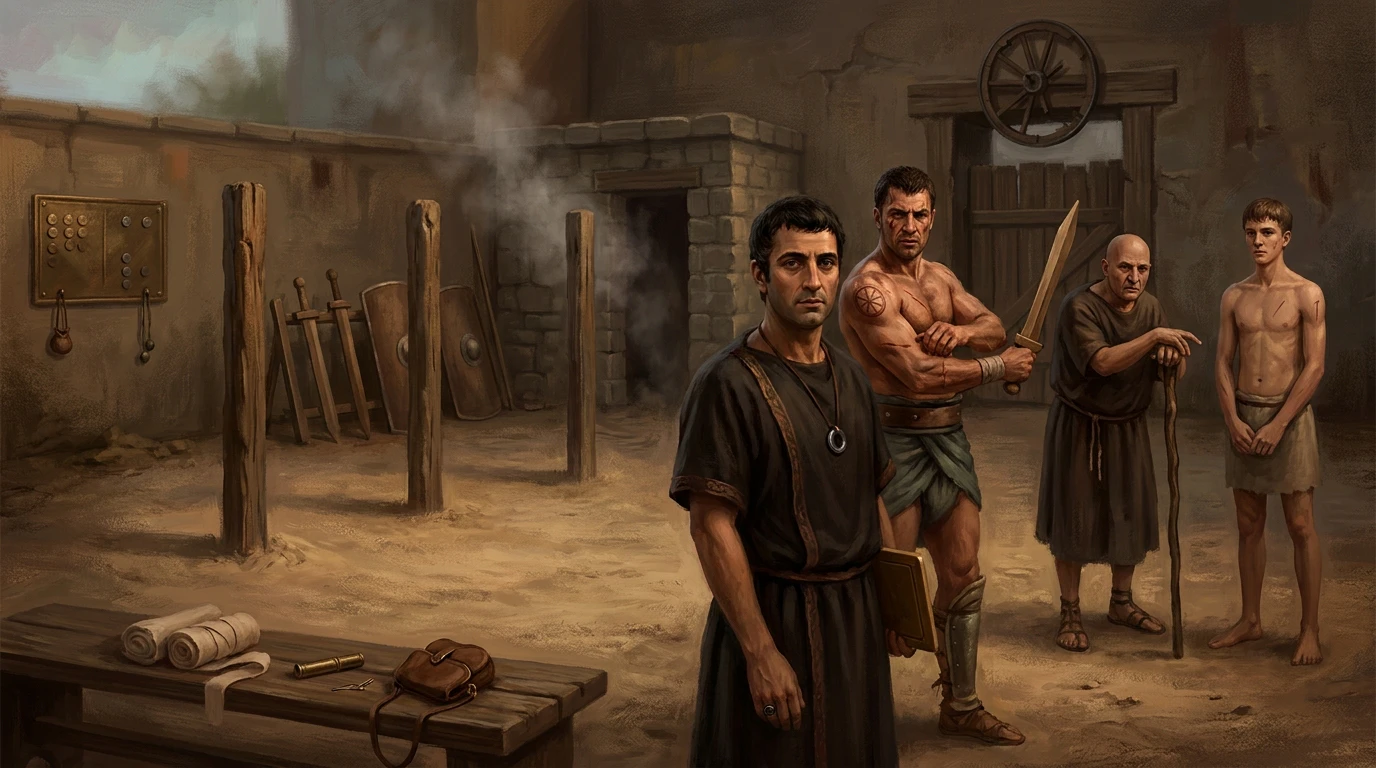
Rome, May 118 AD, in the reign of Hadrian. Just inside the Capena Gate, in a hollow off the Via Appia, sits the Ludus of the Broken Wheel: a walled yard, a barracks, a kitchen, a stone bath-house with a furnace, a training ground of packed sand and four oak posts, and a small shrine of Nemesis by the gate. Over the gate hangs an iron wheel with a single broken spoke — the school's mark, struck into the shoulder of every fighter it owns.
The school holds twenty-two men and four women who fight: Thraex and Murmillo, Retiarius and Secutor, Hoplomachus and Dimachaerus, plus a handful of bestiarii who work the animals. Some are bought, some are bonded, and a few are volunteers who signed for the purse and can read their own contract. Rome's games are a business, and the ludus is a workshop with a debt.
The Ludus of the Broken Wheel deliberately refuses the arena epic. There is almost no glory here. A bout is a business appointment with a numeral chalked at the gate, and the drama is contracts, brands, medicine, and debt. The Tessera Board by the gate holds a bronze token for every fighter; a token stands upright while a man breathes and is laid face-down when he does not. Four are already down. Twenty-six in all.
The Tessera Board
The school's true ledger, read aloud on the first of every month. The men watch which tokens you turn face-up, and the board is the first thing anyone who enters the yard looks at.
The Wheel Brand
An iron brand heated in the furnace and struck into every owned shoulder. Three recruits delivered this month carry the wheel — and their bills of sale name a farm in Campania, not this ludus.
The Bout Ledger
Contracts, odds, purses, wounds, and purchases in a hand that changes every few years and never quite stops. One page, six years back, is blank — and the yard will not say the name that belongs on it.
The Opening Dilemma: Eight Bouts and a Debt
Eros Fable does not ship scripted openings. The engine builds the first turn from the scenario's world lore, its pre-seeded cast, and your character sheet, and it randomizes the adventure's start to any moment within one week after the scenario's canonical date. In the ludus yard that means the school is already in motion: the sand raked, the board with its four fallen tokens, the ledger open on the desk.
The opening the engine aims for is one present person, one explicit want, one withheld piece, and a decision. Here it is the Aedile's games thirty-four days out, eight bouts on your card, the debt falling due at the same games, and three unpapered recruits in the barracks with your wheel burned into their shoulders. The old lanista has been dead nine weeks, and the doctore has told you twice that the sand was uneven that morning.
Protagonist Freedom & Attribute Guide
The default lanista is a suggestion. You may change name, gender, age, height, weight, and background freely, and every NPC in the yard is written to pursue a protagonist of any gender; same-sex encounters are fully embraced whenever you initiate them. The four attributes below are the ones the office demands.
STR — Strength
The yard respects a man who can stand with a shield. Strength is holding a corner in a negotiation with the doctore, catching a fighter who goes down hard, and being physically present in a place that measures people by their bodies.
CHA — Charm
Every relationship here is a contract with a person attached: patrons, bankers, the Aedile's freedman, and the men themselves. Charm is how you buy a week, sell a bout, and keep a fighter fighting for you rather than the purse.
END — Endurance
Games, inspections, creditors, and the summer heat all arrive on schedule. Endurance is the attribute that lets you absorb a bad week in the yard and still be standing at the board on the first of the month.
PER — Perception
Perception catches the shoulder that sits a fraction low, the bill of sale with the wrong name, the witness who leaves the yard when the smith arrives, and the numeral chalked a little too neatly. It is how you find out who killed Verrius.
The Cast of the Ludus
Marcia Vindex
Medica and Freedwoman (39)
Blunt and impossible to shock. She stitched Verrius after the accident and has never described what she saw, and she still wears his ring on her thumb.
Sextus Rubrio
Speculator and Slave-Dealer (46)
Pleasant, patient, and entirely commercial. He supplied this school for nine years, delivered the three new brands with a smile, and has three more men waiting in a warehouse at Puteoli.
Quintus Maecius
Banker of the Equestrian Order (55)
Courteous, slow, and very precise. He holds paper on the school for 90,000 sesterces and has never sent a bailiff — he would rather have your partnership, and he asked about the wells, not the men.
Titus Hostilius Rufus
Freedman of the Aedile (40)
Talkative, shrewd, and pleased with himself. He draws the cards, admires Dama genuinely, and has offered to adjust your card for a consideration he assumes you will pay.
Dama
Thraex and Best Fighter (28)
Proud, quiet, and the man the whole yard organizes around. He has a right shoulder that comes out under a hard shield-press, and the two of you share that fact and have never named it.
Sabinus
New Recruit, Murmillo (23)
Lean, watchful, and slow to trust. His brand is four months old and still scabbed, and he has asked you twice whether a branded man can ever prove he was free — as though the answer matters personally.
Clodia Fuscus
Senator's Widow and Patron (33)
Elegant, decisive, and used to being obeyed. She has offered to buy your debt from Maecius in exchange for the men she chooses, and she has begun to look at you the way she looks at a good horse.
Gaius Veteranus
Doctore (52)
Sour, disciplined, and unexpectedly gentle with the young. He trained Verrius before he trained you, was twelve feet away when he died, and has never once spoken the missing fighter's name.
Starting Possessions, Inventory & Economy
You begin with 4,200 Money: the school's purse, the takings from the last small games, and a betting token that has never been redeemed. Rome counts in sesterces and denarii, and the ludus counts in purses, bouts, and contracts. The debt is 90,000 sesterces and falls due at the Aedile's games; the summer grain fleet, the water rights, and the aedile's licensing fees all land in the same month.
- The Tessera Board — twenty-six bronze tokens, four face-down. The school's true ledger, read aloud monthly.
- The Bout Ledger — contracts, odds, purses, wounds, and one blank page six years back.
- The Wheel Brand — iron on a long handle, heated in the furnace. Every owned shoulder carries it, and three of them should not.
- Verrius's Seal Ring — iron with the wheel in the bezel, for sealing bills of sale and contracts. It came off the old lanista's hand in the yard.
- The Medica's Kit — hooks, linen, forceps, a saw, pitch plaster, and honey. Marcia uses it every night and will not let anyone else put it away.
- The School's Purse — denarii, a few aurei, and one lead token from a betting ring.
- The Doctore's Staff — heavy oak, worn smooth at the grip, used to correct a stance and once a year to beat a man at the post.
Ownership, the Sand & the Adult World
The Ludus of the Broken Wheel runs high heat and takes the ownership of bodies as its engine. The acts are named plainly: oiling and strigiling a fighter after the sand and letting the hands go where they go; a lanista taking his pick of the men on the bench, or being taken by one; fucking a fighter over the rail of the yard while the doctore counts; a patron's widow paying for a champion by the hour and wanting to watch; the bath-house in the evening and whoever stays stays; a man whipped at the post for the yard to see, or fucked at it. Bodies are written honestly — oil, sweat, sand, blood, old whip scars, and the particular sound of a man who has decided to be property.
Sex and access are available from the first week, because the ludus is an owned barracks and you own it. The first full encounter with a named fighter lands in the first third, after you have chosen to protect something you could have sold. What must be earned is the mutual scene — Dama's trust, Marcia's confession, Sabinus's citizenship, Clodia's real affection under her contract — and the most intimate scene is reserved for the night after the games.
Everyone in this yard is legally unfree, and the coercion is the premise rather than a footnote: a fighter who says no with his mouth may not be able to say no with his hands, and the player feels that weight every time. Some men become genuine lovers, some become allies, and some simply endure — the distinction matters to the story and to the board. Eros Fable is uncensored, and the menu of acts is fully open to the player, with consequences that are social, financial, and sometimes fatal.
Running the Yard: Three Survival Tips
lightbulb
Protect Dama's shoulder before the card is drawn. A champion with a hidden injury is worth
less than a dead one, and the men know it. Either find him a bout he can win with a shield on the other arm,
or take him off the card openly and pay the Aedile's office in coin rather than in blood.
lightbulb
Ask the smith who paid for the iron. The three unpapered brands are the whole case, and the
man who heated the iron is one interview away from the truth. Do it before Rubrio's next delivery arrives,
because once the men are in the barracks the paperwork starts to look legal.
lightbulb
Never let Maecius leave the yard without a number. He wants the hollow for its wells and the
road project coming down the Appian Way, and he will trade a week for a signature. Give him an honest figure
and a partnership to consider, and he will keep the bailiffs away while you find Verrius's killer.