This scenario contains: blackmail, graphic violence.
Verity Station: A Crop That Grows on Feeling
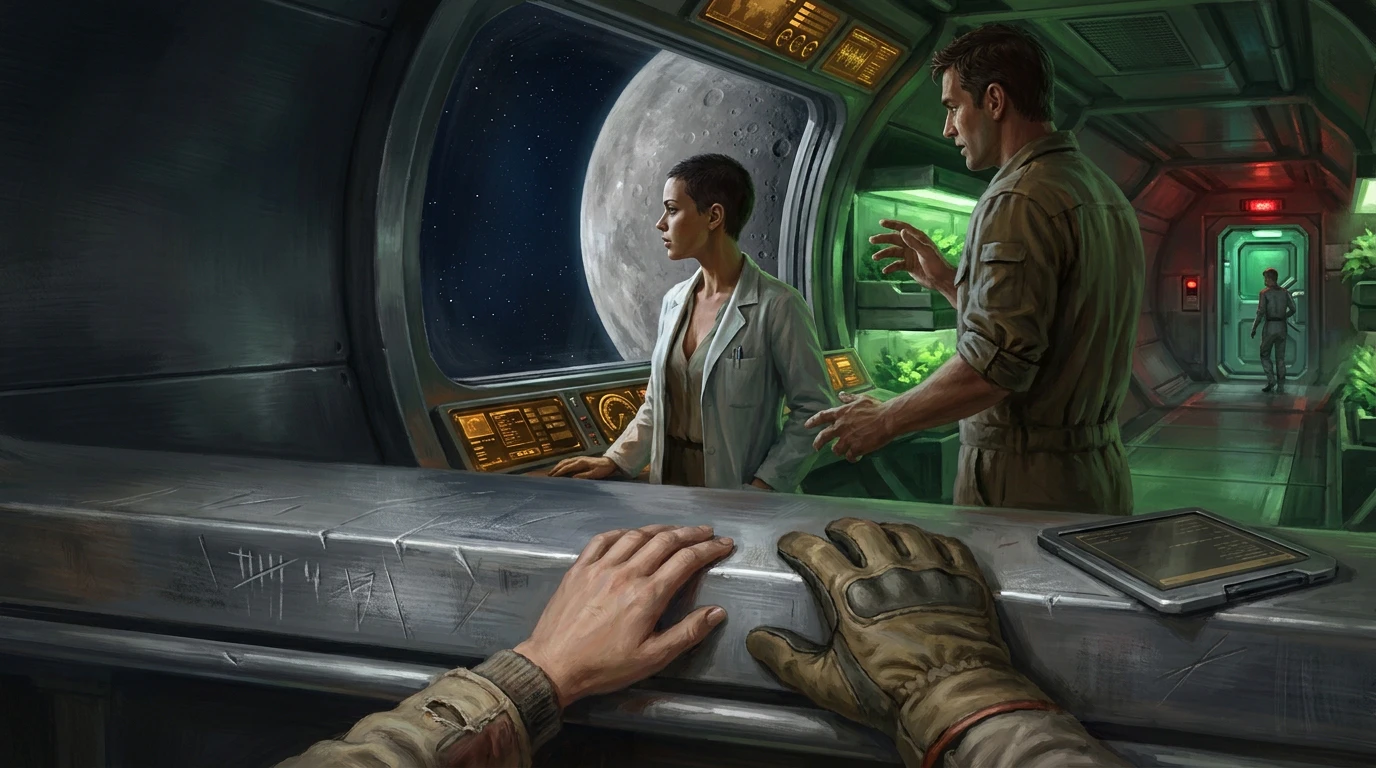
The rings of the gas giant Ossuar, the year 2312. The harvest platform Verity hangs in the ice and dust of the outer ring — a wheel of welded modules, ore silos, a reactor spine, and one long window that looks out on nothing but banded orange storm. Nine men live and work aboard on a company contract. The nearest human being is a relay tower four days away. The nearest law is a contract.
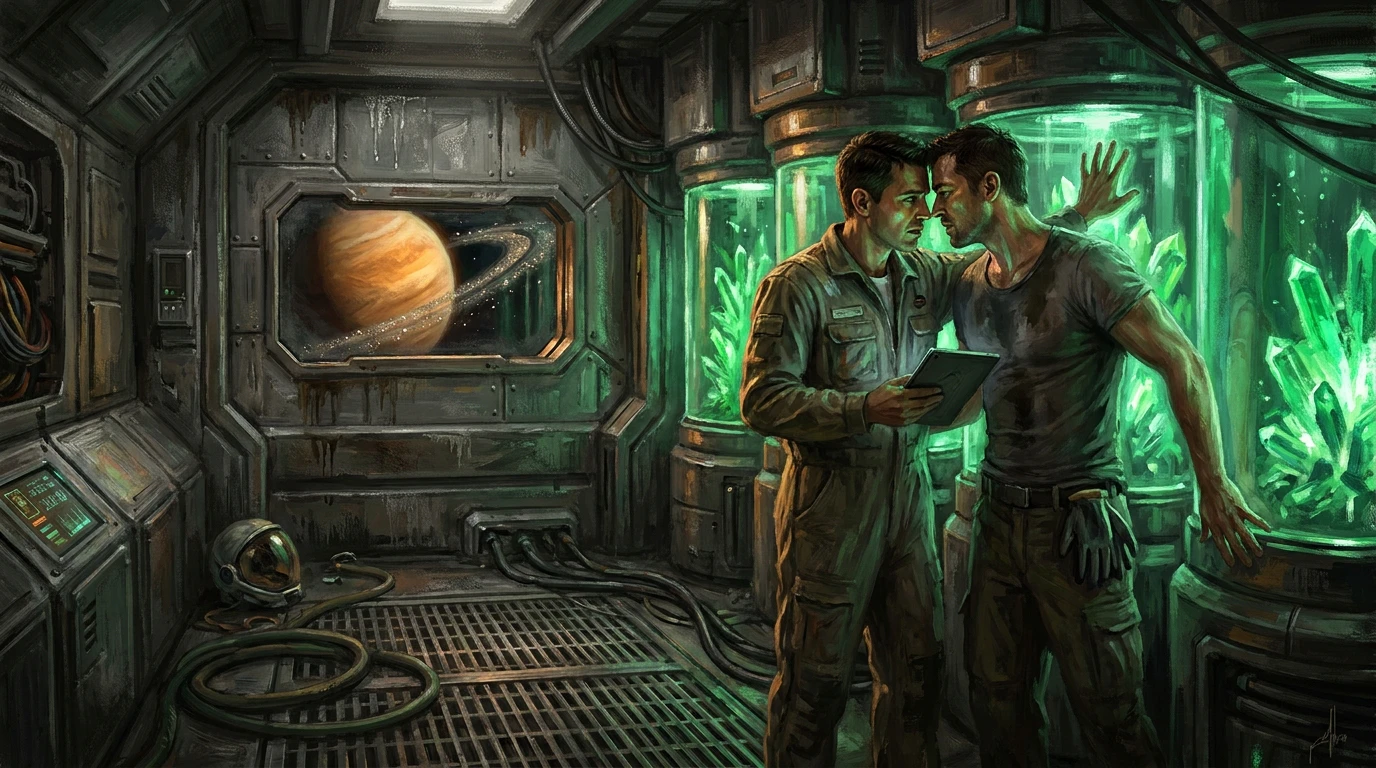
The station's business is the bloom: a xenobiological crystal cultured in a bay of green-lit vats, which grows only in the presence of intense human feeling. Fear, rage, arousal, grief, desire — the crop responds to a room the way a plant responds to light. The company pays by the gram, which means the crew's job, officially, is to keep the station emotionally hot.
Vacuum Bloom is a high-heat science-fiction romance about men who are paid to feel things on command, and about what happens when the feelings become real. It takes the cosy found-family crew of space fiction and turns the dial: this family is manufactured by a yield target, and the station manufactures intimacy the way it refines ore.
The Scale Everyone Watches
The crop's mass sits on a readout in the culture bay, and it rises after every fight, every confession, every coupling, every death. Everyone aboard knows exactly what makes it grow, and nobody will say so out loud.
The Quiet
Every few days the reactor vents, and for six hours all non-essential power shuts down: lights, heat, cameras, comms. During the Quiet the station is dark, cold, and unrecorded — and it has become the crew's real life.
You See Everything
As the new systems reader, you can replay every camera, every corridor, every shift — and your console shows ten people aboard when the roster says nine. What you do with that is the engine of the whole campaign.
The Opening Dilemma: Ten People, Nine Names
Your story begins aboard Verity in the middle of a shift, with the crop behind quota and forty days left before the resupply ship docks. The opening scene is generated by the engine from the scenario's world, its cast, and the character you built, and the exact moment of your arrival is randomised within a week of the scenario's start — so no two contracts begin the same way.
The engine always hands you the same three things in that first scene: one person, one concrete demand, and one withheld detail. It might be the foreman who hired you, explaining a job that does not match the paperwork and asking whether your archive keeps every Quiet. It might be the pilot who claimed the bunk across from yours and wants to know what the last reader saw before he left. It might be the cook who saves you a plate and grows nervous when anyone counts the trays.
Whatever the opening, the console already knows what the crew does not: there is a tenth person aboard Verity, and somebody has been feeding him for eleven months.
Protagonist Freedom & Attribute Guide
The default protagonist is Ilya Novak, a twenty-six-year-old systems reader who grew up on stations and learned early that the person who reads the logs runs the room. As always, the sheet is a suggestion: the scenario is written for a male protagonist and a male-romance readership, while every character pursues a protagonist of any gender and embraces same-sex encounters whenever you initiate them. Customise freely.
INT — Intelligence
Reading a station is a technical skill and a social one. Intelligence is how you reconcile a falsified crop mass, reconstruct a vanished crew's last week from sensor logs, and work out what the Board's factor is actually doing on a claim he should have written off.
PER — Perception
Nine men in a can, and none of them telling the truth. Perception catches the medic's tremor, the mechanic's missing hour in the archive, the cook's extra tray, and the moment a man decides to stop performing for the scale.
END — Endurance
A station at the end of its water is a body problem: bad air, bad sleep, bad food, and the Quiet's six hours of cold. Endurance decides how much of it you can carry before you make a mistake somebody is waiting for.
CHA — Charm
Out here, desire is a quota and everyone is a resource. Charm is how you get men to tell you things they did not mean to, keep a target off a quiet man's back, and turn a transaction into something neither of you planned.
Eight Men Aboard the Verge
The starting cast is pre-seeded with full appearances, motives, and the ability to pursue a protagonist of any gender:
Cass Rudd
Platform Foreman (46)
Patient, calculating, and worn to the bone. He has kept eight men alive on a dying claim by deciding which lie is worth telling. He watches the scale the way other men watch a clock, and he is interested in you in a way that has nothing to do with the crop.
Bram Halloway
Ore Drone Pilot (27)
Reckless, charming, and constitutionally unable to admit fear. He claimed the bunk across from yours on your first shift and has been finding excuses to be in the reader's bay ever since. He is burning his drones out to make quota.
Samir Okonjo
Contract Xenobiologist (24)
Curious, gentle, and a little obsessive. He is the only man aboard who talks about the crop with love instead of hunger, and he has noticed that it responds differently around you than around anyone else.
Teodor Kaska
Night-Shift Reader (30)
Bitter, clever, and always the second-best man in the room. He ran these systems for two years and was passed over for your post, and he has been quietly testing which of your doors he can still open.
Dr. Osric Bell
Station Medic (44)
Clinical, courteous, and hollowed out. He is more honest than anyone aboard about what the station does to people, and he has begun to look at the bloom the way a patient looks at a prescription.
Hollis Dunmore
Cook and Quartermaster (52)
Kind, gossipy, and quietly grief-stricken. He has cooked for four claims and buried two, and he has decided his job is to make sure the men eat and that somebody remembers they were people. He has been stretching the stores further than the numbers allow.
Aldis Crane
Board Factor and Auditor (38)
Polished, patient, and utterly without sentiment. He speaks about men and machines in the same tone, and he has already decided the fate of everyone aboard before he introduced himself.
Grigor Salter
Heavy Cutter (35)
Slow, watchful, and dangerous in the way of a man who has decided that being feared is cheaper than being liked. He was the last person seen with the previous reader.
Beyond the seeded crew, the AI generates and registers everyone else you meet — including the man in the maintenance spine, who is not created until you actually find him.
Starting Possessions & the Board's Economy
You begin with 150 Money in Board credit and a reader's kit:
- Reader's Slate — opens doors, reads sensors, replays the station's logs, and shows a crew of ten when the roster says nine (quest item).
- Service Multitool — cutter, splicer, driver, and a magnetic tip; the man who can fix a door can also lock one (value 30).
- Work Pressure Suit — scuffed, cracked visor, a name stencilled inside that is not yours; the only thing between you and vacuum (value 120).
- Board Contract Chip — your indenture in hard copy. Clause nine covers forfeiture, and nobody who could explain forfeiture has come back to say (quest item).
- Personal Journal — paper, because it cannot be read from the bridge (value 5).
- Flask of Station Spirit — raw distillate traded in the galley; a bottle is an introduction, a bribe, and an apology (value 25).
Your credits cannot be spent until the resupply ship docks, which means the crew's real currency is favours, shifts, contraband, and sex. The Board owns the air; the crew owns each other.
Adult Themes, Romance & the Rules of the Quiet
- A station without privacy. Cameras cover every corridor except during the Quiet, when they are dead. What is said in those six hours cannot be used against a man, and the crew lives by that.
- Heat early, heart late. Intimacy here is casual until it is not; the crew share bunks the way they share tools, and you are free to take any of them to bed in the first act. The first scene that means something lands much later, and has to be earned.
- The crop raises the temperature. Around the culture bay, feelings run hotter and talk runs franker. It is a pressure dial on every scene — never an excuse to overwrite anyone's choices.
- Consent in a flat register. These are practical men: an offer, a nod, a hand on a shoulder, a joke that is not a joke. A no is ordinary and respected — but the station's incentives are not consensual at all.
- Coercion with teeth. Rudd needs the crop fed, Kaska needs you gone, Salter takes what he wants, and Crane can end a contract with a sentence. Those scenes are written explicitly and never resolved into romance.
- Content warnings. Confinement, isolation, and manufactured intimacy; a drug distilled from a living thing; explicit sex between men throughout; blackmail and contract coercion; on-page non-consensual sex and violence.
And underneath all of it, this is a romance: a man who has spent two years deciding which lie is worth telling gets the chance to tell the truth to someone, and the reader who can see every secret aboard gets the chance to be seen.
Survival Tips for a New Reader
lightbulb
Read the archive before you open your mouth. Your console holds every camera
feed, every door log, every shift — and the previous reader's thumbprints all over the
deletions. Learn what was erased before you tell anyone what you have seen.
lightbulb
Use the Quiet for the things that matter. Six unrecorded hours are the only
real privacy on Verity. Confessions, bargains, and beds all live there, and anything you need
to say without it becoming evidence belongs there too.
lightbulb
Decide early whether you are feeding the crop or feeding someone. The scale
rewards real feeling, and the crew rewards the man who can produce it. The moment you start
performing for the readout, everyone can tell — and the romance is the one thing the quota
cannot buy.