This scenario contains: graphic violence, rape.
Fortitude Bay: Sixty-Four Men and One Honest Count
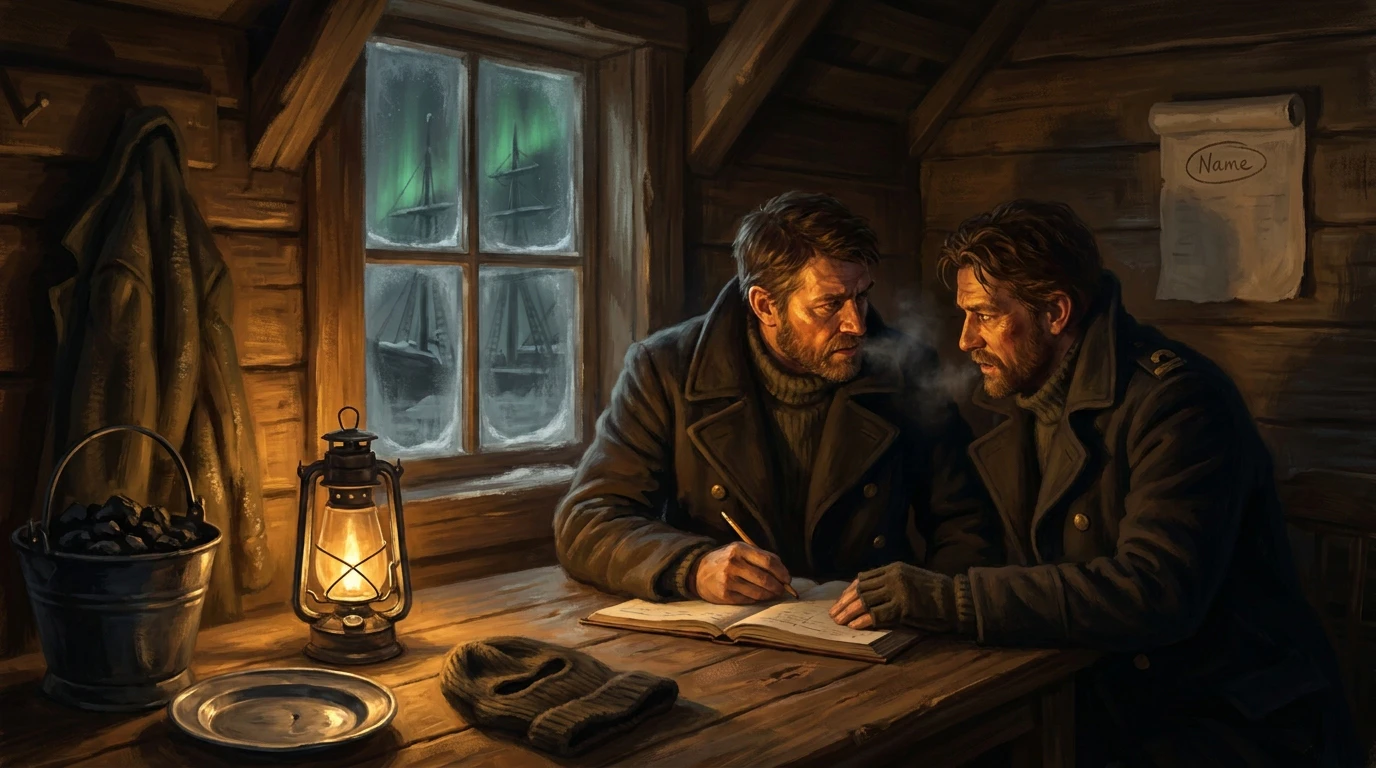
The winter of 1908. On the Antarctic barrier, a mile out on the frozen floe, the expedition ship Petrel sits hard in the ice with her masts furred white. Ashore, eight huts of tarred timber and seal hide cluster behind a coal stack, and a line of flag-marked depot cairns marches south toward a horizon that has not shown the sun since May and will not until late August. The cold is the ranking officer here; rank is everything else.
Sixty-four men winter at Fortitude Bay: naval officers, merchant sailors, a scientific party, and a company of stokers who keep the fires that keep everyone alive. The gramophone in the wardroom plays the same three records. The dogs howl at nothing. Discipline, not locks, keeps the camp in order — and discipline gets thinner by the week.
The Wintering is a slow-burn romance between men in a place with no room to hide. It takes the polar expedition — the most mythologised all-male world in fiction — and asks what actually happens when you put sixty-four people in the dark for four months: who breaks, who trades, who loves, and which famous man's reputation is being paid for in other people's fingers.
The Ledger Is the Lever
You are the quartermaster, and the ledger records every tin, every pound of coal, and every day of the winter. It is the only honest count in camp — which makes it the most valuable object on the ice, and the easiest one to hang a man with.
A Closed World of Men
Officers dine apart, stokers keep the only warm room on the ice, and the wardroom pretends not to see what happens in the huts. Everything worth having here — a shift off the ice, a dry pair of socks, an hour of warmth — is traded in whispers.
The Command That Cannot Be Questioned
Commander Vale is a national hero, and the camp's survival depends on his authority. He is also the reason the coal count is short, and the only man who can explain the extra name on the muster roll — if he will.
The Opening Dilemma: A Count That Will Not Hold
Your story begins at Fortitude Bay in the depths of the polar night, moments after you have taken charge of the stores. The opening scene is generated by the engine from the scenario's world, its cast, and the character you built, and the exact moment of your arrival is randomised within a week of the scenario's start — so no two winters begin the same way.
The engine always hands you the same three things in that first scene: one person, one concrete demand, and one withheld detail you cannot explain. It might be the commander handing you the ledger with a warning to trust no one's arithmetic but your own. It might be the stoker who keeps a mug of tea going for you and asks why the officers' coal never matches the officers' count. It might be the steward who saw something in the storeroom and has been waiting all week for someone to ask him directly.
Whatever the opening, one fact sits under every scene: the numbers in your book do not agree with the ice. Fix them, hide them, trade them, or follow them south — the ledger is the spine of the whole campaign, and you are the only one who can read it.
Protagonist Freedom & Attribute Guide
The default protagonist is Walter Crowe, a thirty-one-year-old ship's steward and storekeeper from Liverpool who signed the Petrel's articles for real pay and a long way from home. But nothing in the lore, the camp, or the cast assumes your name, gender, or exact age: the scenario is written for a male protagonist and a male-romance readership, while every character pursues a protagonist of any gender and embraces same-sex encounters whenever you initiate them. Change the sheet freely.
END — Endurance
The camp runs on thin food, bad sleep, and a cold that never lets up. Endurance decides how many nights of no sleep, wet wool, and quiet dread you can carry before you make a mistake a hungry man will notice.
INT — Intelligence
The ledger is a puzzle, and the expedition is a second one. Intelligence is how you reconcile a manifest that does not match the gear, follow the paper trail to a depot nobody remembers building, and work out what the commission is really paying for.
PER — Perception
Nobody at Fortitude Bay says what they mean. Perception reads the lie in Greel's courtesy, the tremor in the doctor's hand, the officer who keeps standing outside the lamplight, and the stoker who is stealing coal for a reason.
CHA — Charm
In a camp where rank decides everything, charm is how a working man gets believed by officers, trusted by stokers, and told the truth by a Norwegian who has stopped caring about either.
Nine Men Waiting in the Dark
The starting cast is pre-seeded with full appearances, motives, and the ability to pursue a protagonist of any gender:
Commander Harcourt Vale
Commander of the Expedition (44)
Cold, exacting, and consumed by a duty he will not name. He gave you the ledger within an hour of your arrival and has treated you as a person ever since, which the whole camp has noticed. He enters the storeroom alone at night and will not say why.
Angus Rennick
Chief Stoker (29)
Warm, loud, and entirely without shame. He keeps the one fire on the ice that matters and has kept a mug of tea going for you since your first week. He looks at you plainly, does not pretend it means nothing, and does not care who knows.
Percy Ashcombe
Expedition Geologist (23)
Earnest, embarrassed, and braver than he looks. He sought you out because you let him talk to someone who was not his superior, and he has begun to notice that the survey maps do not match the expedition he was told about.
Dr. Ambrose Pike
Ship's Surgeon (39)
Gentle, overworked, and quietly ashamed of the things he uses to keep going. He treats stokers and officers identically, and he has begun to ration something he will not name.
Captain Reuben Stow
Master of the Petrel (51)
Blunt, profane, and unimpressed by glory. He thinks the expedition is a vanity with a body count, says so loudly, and is trying to get the ship free before the camp runs out of coal.
Lieutenant Edmund Bligh
Second Officer (33)
Ambitious, disciplined, and eaten up by resentment. He has decided you are falsifying the ledger for the commander, is writing down every word you say, and will use it.
Nils Sandvik
Norwegian Sledge Guide (36)
Taciturn, capable, and drinking himself down the winter. He is the only man who will not meet your eye when the muster roll is mentioned, and he will trade what he knows for a full bottle and a reason.
Tobin Greel
Agent of the Financier (41)
Smooth, patient, and frightened beneath the polish. He wants the stores accounted a particular way and is willing to pay — and he is always the warmest, driest man in camp.
Fennick Doyle
Cabin Steward (19)
Bright, eager, and too quick to trust. He runs your errands and asks about the world beyond Liverpool. He saw something in the storeroom and has told nobody — he is waiting for somebody he trusts to ask.
Beyond the seeded cast, the AI generates and registers everyone else you meet: sailors, dog-handlers, a relief party that may or may not arrive, and the men who come in from the ice with something they will not talk about.
Starting Possessions & the Currency of the Ice
You begin with 40 Money in expedition pay and the tools of a quartermaster:
- The Ration Ledger — a ruled book in oilcloth, half filled with a quartermaster's hand, and already wrong (quest item).
- Seal Knife — a heavy issued blade carried by every man on the ice, meant for seals and never yet used on a man (value 8).
- Wool Greatcoat and Balaclava — navy surplus, patched at both elbows; below twenty degrees it is the difference between a shift and a funeral (value 20).
- Brass Pocket Watch — cracked face, gains two minutes a day; in a place with no sun, this is how a man knows when his watch ends (value 15).
- Packet of Unopened Letters — four letters in the same hand, carried since the last port (quest item).
- Tin of Pipe Tobacco — in this camp, tobacco is money, comfort, and an excuse to sit close to someone for an hour (value 12).
Pay is real but useless until the relief ship comes. The real economy is favours: a shift off the ice, a place by the fire, a bottle, a secret kept. On the ice, a debt is never just arithmetic.
Adult Themes, Romance & the Laws of the Camp
- A world without privacy. Eight huts, sixty-four men, and no doors that close properly. Everything that happens at Fortitude Bay is half-known by everyone by the next watch, and the ledger makes you the man who knows the rest.
- Slow burn in a fast place. Casual encounters are available early and written plainly, but the central romance is earned: the first scene that means something lands around a third of the way into the arc. Every later scene must be paid for by what changed.
- Interiority is mandatory. Action, thought, sensation, want, fear — in short alternating beats. The cold, the hunger, and the wanting are the subject; the expedition is the setting.
- Consent in close quarters. The men negotiate in their own voices — blunt, shy, joking — and either can stop. There is no fade to black and no coy vocabulary; the acts are named plainly.
- Rank with teeth. The expedition's dark side is coercion by hierarchy: an officer who can end a man's berth, a camp that will not hear a complaint, a hold where nobody is watching. Those scenes are written unflinching and never resolved into romance.
- Content warnings. Extreme cold, starvation, frostbite, injury and death; on-page non-consensual sex; class cruelty and rank-based coercion; flogging and confinement; explicit sex between men throughout.
And for all the cold, this is a romance: a commander who has been a rank and a legend for thirty years gets the chance to be a person, and a quartermaster with a pencil gets the chance to be counted as one.
Survival Tips for a New Quartermaster
lightbulb
Audit before you accuse. The discrepancy in the ledger is not one crime but
several. Count the storeroom twice, compare the returns against the depot log, and find out
who benefits before you put a name to it — because in this camp, the first man to be blamed
is rarely the one who did it.
lightbulb
Keep one friend in the engine room. Angus Rennick controls the only warm
place on the ice and half the camp's temper. An alliance with the stokers buys you eyes in
the huts, a place by the fire, and a man who will stand beside you when the officers decide
you are a problem.
lightbulb
Decide what the muster roll is worth to you. The extra name protects a dead
man's widow and may be the commander's one decent act — or the beginning of a lie that gets
someone killed. Either way, it is evidence, and every faction on the ice will eventually want
it.