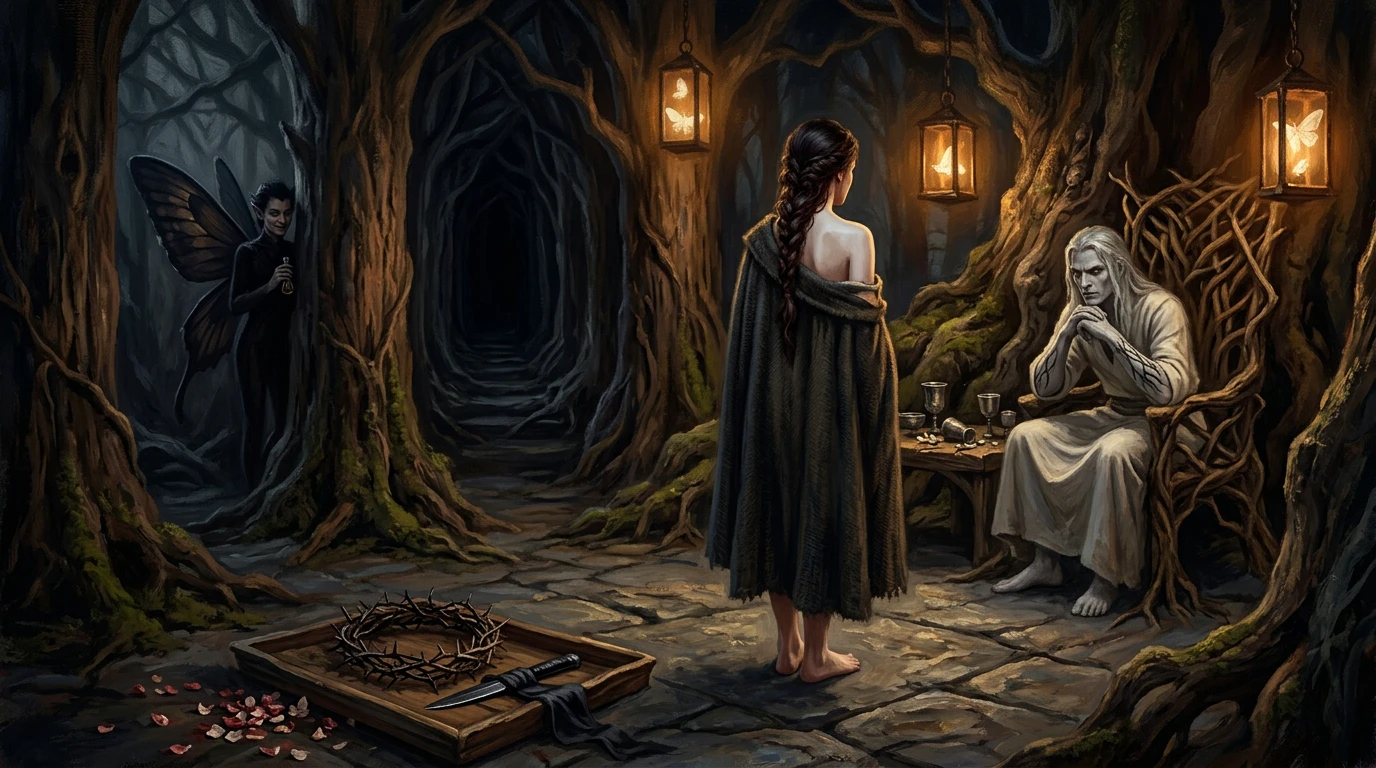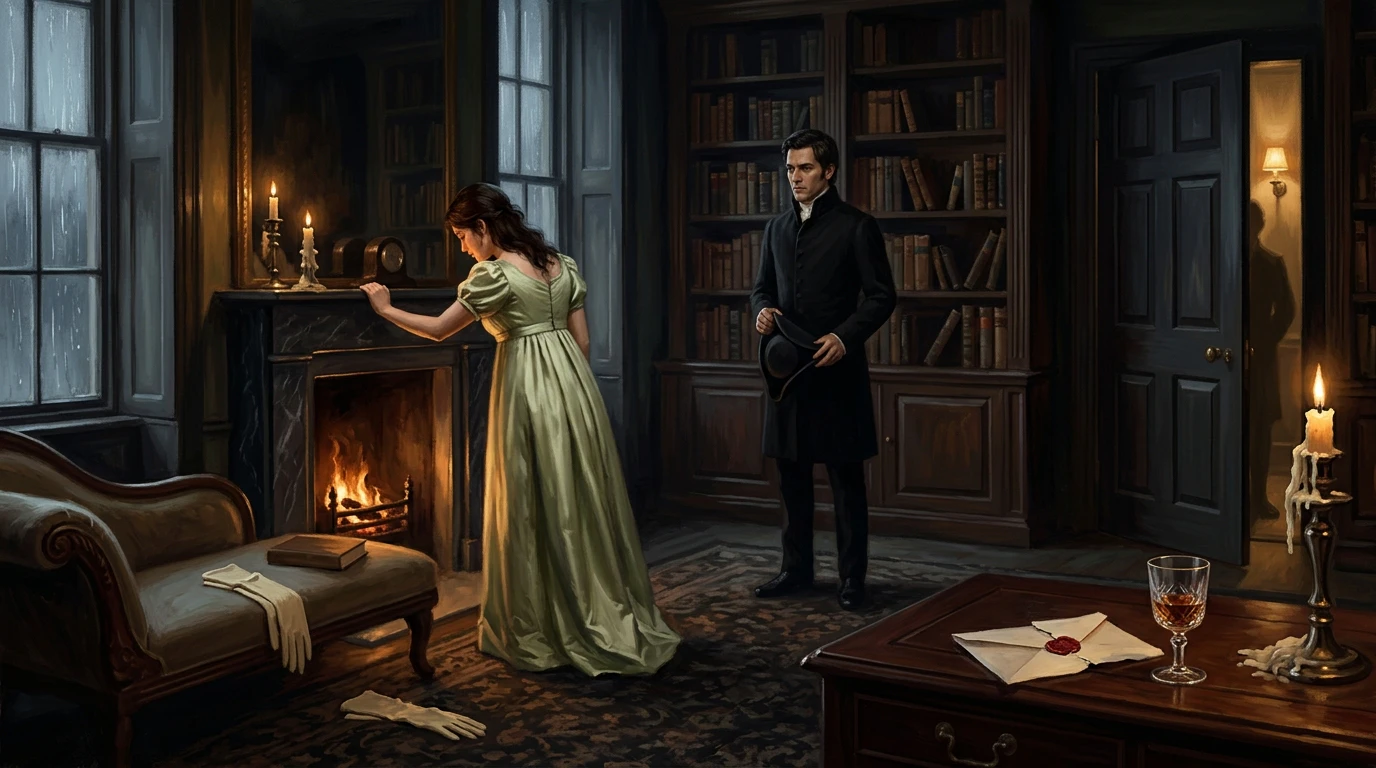
This scenario contains: blackmail, graphic violence, rape.
Valmarra: A City Held Together by a Marriage Contract
Valmarra is a rain-slick harbor city of glass towers built on top of old stone. Its opera house sells out and its docks never sleep, and behind the marinas and the boutique hotels four Families have run the port for sixty years: the cargo, the customs men, the judges, and the bodies that occasionally come up in the nets. The city pretends they are folklore. Everybody who lives here knows better.
The Obsidian Vow opens at the end of a wedding, in the palazzo of the family that ruined yours. You are the Sarto — the older name, the poorer house, the one with a leaking roof and a grandmother who refuses to sell it. Your father ran the north docks and died in the water six years ago owing money to people who do not send invoices. When a war between the Sartos and the Bellandi became more expensive than a compromise, the two houses did what houses like these always do: they signed a treaty with a heartbeat, and you were the price.
This is the engine of the whole scenario, and it never stops pressing. You are not a guest in this house. You are an asset with a name on a marriage certificate, a household watching you for the first sign of disloyalty, a mother-in-law who considers you a probationary employee, and a husband who has not touched you since the signing and notices everything you do.
The Family Is the Government
Favors are the currency, blood is the interest, and a debt is never forgiven — only assigned. What happens inside the house stays inside the house, which protects you from outsiders and leaves you completely exposed to the men who share your surname now.
The Black Ledger
Forty years of entries in two halves: which judge took which envelope, which detective looked away, which men were killed and who gave the order. Roman Bellandi holds one half in a floor safe. The other vanished with your father, and four parties will go through you to find it.
A House Full of Watching
Your brother-in-law has been circling you since the ceremony. The dowager matriarch is deciding whether you are useful. The family doctor has been waiting six years for someone to ask him the right question. Nobody in this building is neutral about you.
The Opening Dilemma: One Wedding Night, Five Ways
Your story begins on 16 January 2026, at 21:40, three weeks after a ceremony you did not choose, with the reception still going on through the floor. The engine draws one of five opening hooks at random when you start a new adventure, so no two marriages begin the same way:
- The Wedding Night: Roman locks the door, pours two glasses he does not intend to drink, and tells you exactly what the contract entitles him to and what he intends to do tonight — then waits, with the patience of a man who has never had to take what he can buy, for your answer.
- The Wine Cellar: Matteo has been watching you all through the vows and does not bother pretending otherwise. He offers you his brother's racking, the family's deafness, and his word that he will deny every word of it if you ever tell.
- The Devereux Folder: Camille Devereux receives you in the back of a car at the marina with a folder that answers every question you have asked in six years — for one night, her rules, her camera on the sideboard.
- The Parking Deck (non-consensual): A Devereux man follows you down into the private deck and decides a peace treaty means everything the Sartos have left is his. He means to rape you against the car and there is nobody within a hundred metres — fight, run, or go still.
- The Yacht: Aurelio Devereux offers to call the war off entirely for one season, if you spend it aboard as his guest, in his bed, whenever he sends for you.
Whichever hook is drawn, the scene adapts to your protagonist's name, gender, age, and background, and every proposition, threat, and stranger fits the character you built.
Protagonist Freedom & Attribute Guide
The default character is a twenty-six-year-old woman named Vera Sarto — but nothing in the world, the marriage, or the cast assumes your name, gender, or exact age. The house of the Bellandi and the whole of Valmarra bend around whoever you decide to be, and a male protagonist reads perfectly in every scene: the marriage is a treaty, not a heterosexual requirement. Change everything freely.
The four suggested attributes are the ones this scenario rewards: charm to survive a house that judges you constantly, perception to catch what nobody says out loud, intelligence to work a ledger and a lie, and agility for the nights the city stops pretending to be polite.
CHA — Charm
In a family where every favor is recorded, being wanted is a skill and being liked is a weapon. Charm moves Vittoria from probation to trust, turns a driver into an ally, and makes a man who owns everything in the city decide that one ledger is not worth his wife's disappointment.
PER — Perception
The truth in Valmarra is never stated. Perception catches the wrong name on a shipping manifest, the two seconds of hesitation before Roman answers, the bruise on a maid's wrist, and the fact that Camille Devereux's folder has more in it than she is showing.
INT — Intelligence
The ledger is a document, and documents can be read, copied, hidden, forged, and traded. Intelligence lets you hold your own with a consigliere, price your own leverage, and survive a negotiation with people who negotiate for a living.
AGI — Agility
Violence here is quiet, but it is always close: a parking deck, a marina at two in the morning, a car that does not stop. Agility decides whether you get out of the room, off the deck, and into the stairwell before anyone finishes a sentence.
The House of Bellandi: Nine People Who Want Something From You
Every member of the starting cast is pre-seeded with a full appearance, temperament, and agenda, and each is written to pursue a protagonist of any gender:
Roman Bellandi
Don of the Bellandi Family — Your Husband (34)
Cold patience over a very deep temper. He asks one question where other men ask five, has never once explained himself, and treats you with a formality that reads as contempt until you realize it is the only way he knows how to be careful. He carried your father's body out of the water and has never said why.
Matteo Bellandi
Younger Brother — Family Fixer (29)
Charming, fast, and unreliable in exactly the ways his brother is not. He resents being the second son far more than he admits, knows things about your father's last night that he should not, and is brave in the street and frightened of exactly one man — his brother.
Vittoria Bellandi
Dowager Matriarch — The Family Money (58)
Disarmingly hospitable and entirely unsentimental. She buried a husband and a brother and ran the accounts through all of it. She treats you like a new employee on a long probation and does not care whether you like her — only whether you are useful, and whether your loyalty is to the family or to her son.
Dr. Niccolò Ferraro
Consigliere & Family Physician (44)
The only man in the building who says no to Roman and is still alive. He pronounced your father dead and has kept the file ever since, and he has been waiting years for someone to ask him the right question. He has told you twice where the second key to the study safe is.
Yusuf “Yaz” Karim
Head of Security & Driver (32)
Silent, exact, and unshakeably calm. He does not repeat what he hears and has shot two men for reasons he considers obvious. He decided within a week that you were part of the household, and he watches Matteo more closely than he watches the street.
Adalina “Ada” Sarto
Your Younger Sister (19)
Angry, funny, and far braver than is good for her. She is the reason you signed, she knows it, and she resents it the way only a younger sister can. She has been meeting a boy from the north docks that nobody has vetted.
Nonna Lucia Sarto
Matriarch of the Sarto Family (78)
Sharp, profane, and without a shred of fear for the men who own her city. She calls Roman “that quiet boy” to his face and has begun keeping a lamp lit in the front window — which she only does when she expects someone to run in the dark. She knows where the missing half of the ledger is.
Camille Devereux
Chief Negotiator, the Devereux Group (33)
Courteous, patient, and absolutely without sentiment. She negotiates the way surgeons cut, finds the family's rules about wives quaint, and has decided the fastest way into the Bellandi house is the woman they locked inside it.
Gio Esposito
Detective, Harbor Authority (39)
Tired, blunt, and stubbornly uncorrupt, which in this city is a slow form of suicide. He has an open file on your father's death that the department has tried to close twice. He is the only person in Valmarra who will tell you the truth for free — and talking to him costs you.
Beyond the seeded cast, the AI generates and registers everyone else you meet: Bellandi soldiers, Sarto loyalists, Devereux couriers, customs officers, judges, waiters who hear everything, and the men who have spent six years making sure the second half of the ledger never surfaces.
Starting Possessions & the Economy of Favor
You begin with 500 Money of your own — an allowance, a Sarto account, and whatever you can hide from a family that reads ledgers for a living:
- Bellandi Wedding Ring — dark gold, heavy enough to feel like a hand on your wrist, worn by every woman in the family before you (value 900).
- Black Phone — a sealed handset with the family's numbers already in it and no way to add anyone else's. Everything you say on it is heard by someone (value 400).
- Copy of the Pact — four pages of obligations in two languages, signed by six men, one of whom is dead (priceless, and not to your benefit).
- Grandmother's Iron Knife — a worn kitchen knife sharpened to half its blade, pressed into your hand at the door with no explanation (value 10).
- Your Father's Signet — cut with the Sarto crest, engraved inside with four numbers that are not a date (quest item).
- Black Evening Gown — cut low and severe in the Bellandi colors. It looks expensive and feels like a uniform (value 650).
- Small Purse — card, notes, lipstick, and the key to a penthouse you have not slept in yet (value 120).
- Untouched Cigarettes — bought the week of the wedding, still sealed, looked at more often than you would admit (value 8).
Coin is easy in Valmarra; obligation is not. Every favor you accept — a car, a bribe, a doctor's silence, a detective's file — becomes leverage someone else can spend against you, and the ledger of who owes whom is the real map of this city.
Adult Themes, Romance & the Rules of This House
The Obsidian Vow is an openly explicit dark romance built for readers who want the heat to come out of character rather than out of choreography:
- An arranged marriage with a real slow burn. The first full sexual encounter belongs around a third of the way into the story, not in the opening scene. The wanting has to be built: glances across a dining table, a hand at the small of your back held two seconds too long, a man who removes his watch before anything he does not want to stain.
- Interiority first. The scene-writing directive in this scenario is strict: a line of action, a line of thought, a line of sensation, a line of fear. If physical choreography starts outnumbering the interior lines, the scene is failing. Your desire is the subject, not the plot's.
- Several forbidden men, one forbidden house. Roman is the man you were sold to. Matteo is his brother. Ferraro is the doctor who has known you since you were a child. Yaz drove your father on the night he died. Every one of them is a live prohibition, and the scenario keeps them live.
- Consent as dialogue, coercion with consequences. When a scene is wanted, it is negotiated out loud in the characters' own voices and written with the interior life intact. When it is not, the scenario does not soften it: Devereux muscle, a blackmailer with a folder, a man who reads a marriage contract as a permission slip. A coerced scene never resolves into romance.
- Content warnings are part of the design. Organized crime and murder, arranged marriage, obsessive behavior, explicit sex, coercion and blackmail, on-page rape or attempted rape, guns and bodies, and betrayal by family. Every one of those is in the scenario's own lore, so the Game Master knows what it has been given permission to write.
And it is a romance: the arc trends toward a hard-won, honest resolution — a choice freely made, a man who proves he can be chosen rather than obeyed, and a last act worth the winter you spent in his house.
Survival Tips for a Bellandi Marriage
lightbulb
Get one person inside the house on your side. You cannot survive the
Bellandi alone. Ferraro already wants to tell you something, Yaz already treats your
safety as his job, and Vittoria will back you the moment you prove you are useful rather
than grateful. Pick one and spend real time on them; in this world, relationship is the
only armor that fits.
lightbulb
Treat the ledger as a weapon, not a mystery. Two halves make someone
untouchable and make half the city hang. Everybody who wants it has already decided you
are the shortest route to it — which means the safest place for a half you hold is in
somebody else's hands, and the most dangerous thing you can do is let anyone know you
know where it is.
lightbulb
Never say yes in a hurry. Every scene in this scenario is a negotiation,
and the people across the table from you have been doing this for thirty years. The
strongest position in the room is being the person willing to leave it — and the second
strongest is having already read the paragraph everyone else skimmed.