This scenario contains: blackmail, rape.
Cinderhall: The Court That Is Losing Its War
Spring, the year 1311. The Ashen Marches are a cold upland country of black pines, drowned bogs, and villages that pay a debt their grandparents made. Above the treeline stands the Ashen Tree: a dead colossus the height of a cathedral, bark white as bone, its roots spread for a mile. Beneath those roots, in halls of rootwood and amber, lives the Ashen Court.
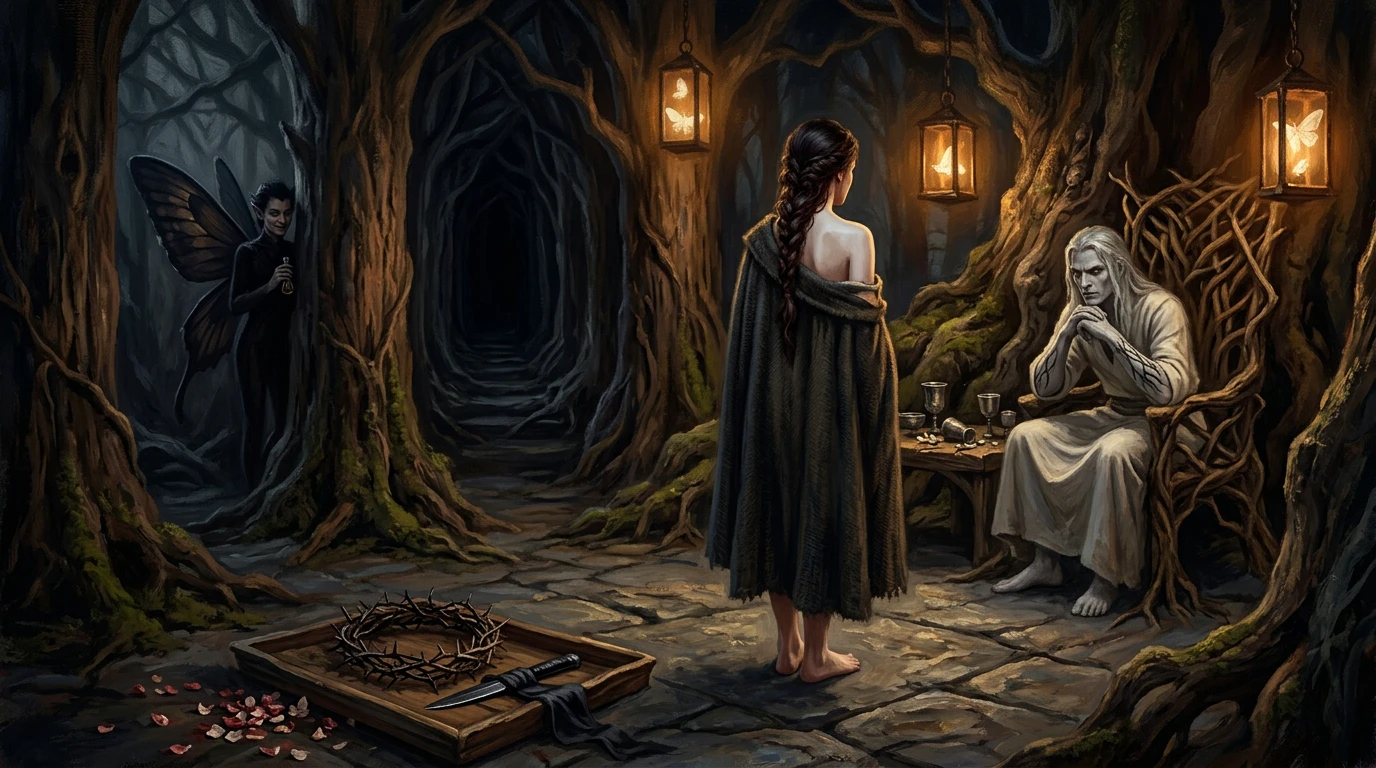
Once every seventh year, the villages of the Marches give one soul to that court. It is called the Tithe, and it is dressed in ceremony: white cloth, a wreath of dried thorns, a walk up the hill with the whole village behind you and nobody saying your name. This spring, the wreath was put around your neck.
The Ashen Tithe is a romantasy that takes the faerie bargain seriously and builds its whole plot on the answer to one question: what is the Tithe actually for? The villages believe the fae take one to keep the rest, and that the one is never seen again. What is true is stranger and worse. The Tithe is not a tribute. It is a lock. Under the Ashen Tree sleeps Vharr, the Cinder Below — a god that was burned and buried before the first village was built — and the Bargain that keeps it asleep is renewed by blood given freely at the turning of every seventh year.
The fae are not monsters feeding on mortals. They are jailers, and they are losing. The court itself is dying: not of age, but of the failing Bargain. Every year the Ashen Tree grows a little colder, and every year Cinderhall loses someone to the dark under the roots.
Bargains Are Physical
A promise made in Cinderhall can be called in, traded, or used to kill you. The fae cannot lie, but they will spend a lifetime bending a single sentence — so the whole world runs on precise wording, debts, and the horror of having given your word.
A Dying, Beautiful Court
Moth-winged healers, bone-thin duelists, creatures who were somebody's gods three hundred years ago and now pour wine. Proud, bored, cruel in the way of people with nothing left to lose, and hospitable in the way of people who have not had a new guest in seven years.
The Frost Court Watches
Queen Aelryn of the Frost believes the Ashen Tree should be opened, not guarded — that what sleeps beneath it can be harvested and worn. She has agents inside Cinderhall, an army in the passes, and a very specific use for a newly given tithe.
The Opening Dilemma: Your First Nights in Cinderhall
Your story begins on 2 April 1311, at 19:40, hours after your village walked you up the hill and left you at the root-door. The engine draws one of five opening hooks at random each time you begin, so no two tithes arrive the same way:
- The Ash Lord's Chamber: Sennavar undresses to the waist and tells you plainly that he means to take you to his bed tonight, that he will not be gentle about wanting it, and that your no will be honored without argument. Lanterns burn low. The court is listening through the walls.
- The Frost Queen's Knife: A messenger in white furs brings a blade of cold iron wrapped in silk and an offer: kill the Ash Lord in his sleep and the way home opens. The price she names first is a night in her own chambers, and she expects agreement now.
- The Gallery of Revels: Tavish pulls you into the gallery above the great hall, where the court has stopped pretending the revel is about dancing. He tells you exactly what he wants to do to your mouth while you watch, and offers to teach you the only etiquette that matters here.
- The Stables at Midnight (non-consensual): A fae huntsman decides a tithe has no say in who uses her before the lord gets his turn, and pushes you down into the straw with his hand already at your belt. The court would never punish him. Fight, run, bargain, or go still.
- The Voice Under the Roots: Something below knows your name. It speaks in your own voice and offers power, truth, and a way out of every bargain — if you come down alone and let it use your body as a door.
Whichever hook is drawn, the scene adapts to your protagonist's name, gender, age, appearance, and background, so the court's appetite always fits the character you built.
Protagonist Freedom & Attribute Guide
The default protagonist is Elowen Marsh, a twenty-four-year-old woman from the smallest March village — but the scenario is written with complete protagonist ambiguity. Nothing in the lore, the court, or the cast assumes your name, gender, or exact age: every fae in Cinderhall pursues a tithe of any gender, and same-sex encounters are embraced whenever you initiate them. Change the character sheet freely.
CHA — Charm
Cinderhall is a room full of bored predators with excellent manners. Charm is how a mortal with no magic becomes the most interesting person in the hall, moves the Ash Lord off his own script, and turns a courtier's gossip into a plan.
PER — Perception
Nothing in this court is stated plainly. Perception reads the second meaning in a bargain, the missing names in the Bargain's book, the way Maelis's hand never leaves her knife, and the fact that the last three tithes did not reach the roots alive.
INT — Intelligence
You cannot out-muscle a fae; you can out-think one. Intelligence is what lets you survive a negotiation with a creature that cannot lie, follow the paper trail in Rhoswen's archive, and work out what the Bargain actually requires before it costs you everything.
END — Endurance
The Marches are cold, the halls are colder, and the thing under the floor takes its time. Endurance decides how many nights of no sleep, thin food, and quiet terror you can carry before you make a mistake that a fae will notice.
Nine People Waiting for You Beneath the Tree
The starting cast is pre-seeded with full appearances, agendas, and the ability to pursue a protagonist of any gender:
Sennavar, the Ash Lord
Lord of Cinderhall — Keeper of the Bargain (33)
Cold, courteous, and exhausted in a way he would never admit. He does not lie, he does not flatter, and he asks for what he wants in words that leave no room for guessing. Under the discipline is a frightening amount of feeling and a certainty that wanting something is the fastest way to lose it.
Maelis Vess
Spymaster & Sworn Blade (27)
Loyal, suspicious, and completely unimpressed by mortals. She has been Sennavar's shadow since she was a girl and has decided you are either the last piece of the Bargain or the thing that finally kills him. She watches you sleep for the first three nights and will admit it if confronted.
Orrin Thale
Mortal Knight of the Ash Court (29)
Steady, courteous, and quietly heartbroken. He was given to the court in a tithe twenty years ago and stayed because he was asked to — the only mortal in Cinderhall who chose it twice. He keeps a list of every mortal who has come here, and three of the names were yours to inherit.
Queen Aelryn of the Frost
Sovereign of the Frost Court (38)
Gracious, patient, and entirely without mercy. She collects beautiful things and useful people, keeps both in good order, and does not distinguish between them. She never raises her voice and never forgets a refusal.
Tavish
Moth-Winged Courtier, Poisoner & Healer (24)
Delighted by everything and loyal to nothing. He cannot lie, but he can arrange a sentence so carefully that the truth of it cuts on the way out. He wants to know what you will do when pushed, and he will supply the push himself if nobody else gets around to it.
Briar
The Last Tithe — Half-Turned (25)
Small, angular, and going the pale gray of birch bark, with a few smooth twigs growing through her hair. She knows what happened to the tithes that went down to the roots because she was there, and she has never told anyone. She has taken to sleeping outside your door.
Ilse Marrow
Tithe-Warden of Thistlemoor (55)
Practical, unsentimental, and carrying a weight she will not put down. She has walked seventeen tithes up the hill and brought nothing back. She chose you for the tithe, and she has not yet told you why it had to be you.
Cerin Vael
Sennavar's Elder Brother — Chained Below (37)
Charming, lucid, and entirely insane in the way of someone who has been alone with a god for seven years. He was lord of Cinderhall before he went under the roots and is believed dead by everyone but his brother. He has begun speaking to you in your sleep.
Rhoswen of the Lamp
Court Archivist — Keeper of the Bargain's Book (61)
Pedantic, humane, and very tired. She has kept the Bargain's book for two hundred years and knows where it was altered, and she is afraid of whoever altered it. She is the only member of the court who has never once asked you for a thing.
Beyond the seeded cast, the AI generates and registers everyone else you meet: courtiers, huntsmen, frost envoys, mortal villagers on the road, and the things that come up out of the roots at night.
Starting Possessions & the Currency of the Marches
You begin with 60 Money — fae silver, worth more than it looks — and the entire contents of a village life:
- Tithe-Mark Pendant — a disc of blackened silver stamped with the Ashen Tree. The whole court can read it at a glance: you belong to Cinderhall now (quest item).
- Hidden Iron Knife — cold iron sewn into the hem of your cloak. It burns the fae like held flame, and every courtier already knows you have it (value 15).
- Wool Travel Cloak — patched at the elbow and still smelling of home. Nobody in the court wears anything like it (value 12).
- Your Mother's Letters — nine letters in a hand you know better than your own. She left the Marches in another tithe year and did not come back (quest item).
- Wreath of Dried Thorns — kept because you could not make yourself throw it away (value 0).
- Purse of Fae Silver — a clasp that opens only for the hand that first closed it (value 60).
- Plain Silver Ring — worn on the thumb, scratched from a thousand turns, pressed into your hand by Briar within an hour of your arrival (value 5).
Fae coin buys mortal bread, court clothing, and favors. But the real currency in Cinderhall is the promise: a favor given is a debt created, and a promise made badly is the most expensive thing a mortal can own.
Adult Themes, Romance & the Laws of the Court
- A court that watches. Cinderhall has had seven years to think about the new tithe, and it does not do privacy. Being desired, discussed, and propositioned by beautiful amoral beings is the permanent weather of this scenario — and the writing has to hold the threat and the thrill of that at the same time.
- Slow burn first, explicit after. The scenario's own directives forbid rushing: yearning, misreading, and near-misses come first, and the first full encounter belongs around a third of the way into the arc. Every scene after that has to be paid for by the emotional ground beneath it.
- Interiority is mandatory. Action, thought, sensation, want, fear — in short alternating beats. If the choreography starts outnumbering the interior life, the scene is failing. Your desire is the subject; the court is the setting.
- Consent as a real bargain. When a scene is wanted, the fae say out loud what they want and what they will not do, and their yes is specific, strange, often cruel, and still a yes. There is no fade to black and no coy vocabulary — the acts are named plainly.
- Coercion with teeth. Fae who consider a tithe to be livestock, a queen who collects people like jewels, and a thing that has waited six hundred years for a door will corner, coerce, and rape. Those scenes are written unflinching and never resolved into romance.
- Content warnings. Captivity and forced proximity, a bargain that trades the body, obsessive and possessive behavior, explicit sex, coercion and blackmail, on-page rape or attempted rape, body horror and a hungry thing under the floor, fae cruelty, and a world that is running out of time.
And for all the horror, this is a romance: a lord who has spent three hundred years obeying a bargain gets the chance to choose something for himself, a jailer becomes a person, and the last act earns its ending.
Survival Tips for a New Tithe
lightbulb
Never give your word casually. In Cinderhall a promise is a physical
thing with teeth. Answer questions with questions, negotiate the wording before you
agree to anything, and remember that the fae cannot lie — which means every sentence they
speak has been chosen with a knife's precision, including the ones that sound kind.
lightbulb
Find out what the Bargain actually is before you decide who to trust.
Sennavar is keeping the god asleep, Aelryn wants it woken and harvested, Cerin below the
roots wants the crown back, and Briar knows what happened to the tithes that went before
you. Everyone in this court is telling you a true thing that serves a lie.
lightbulb
Build one alliance with a mortal. Orrin Thale has survived twenty years
here by knowing when to be useful and when to be invisible, and he is the only person in
Cinderhall whose loyalty is not priced in magic. He is also in love with Maelis, which
makes him either your best leverage or your biggest liability.