This scenario contains: blackmail, rape.
Fallow Creek: Nine Hundred People and One Unfinished Thing
Fallow Creek, Cedar County, October 2026. A timber town of nine hundred people at the end of a two-lane road, wrapped in second-growth pine and permanent wet. The mill closed in 2011. What is left is a diner, a hardware store, a church with a bad roof, a volunteer fire department, and a reservoir that drowned a town nobody living remembers. Everybody knows everybody. Everybody has agreed not to talk about certain things.
The Watcher in the Pines drops you into a house nobody has lived in for nineteen years: the Calloway farmhouse on Ridge Road — four rooms, a wood stove, a wraparound porch, and forty acres of pines running down to the water. June Calloway walked out of it one night in 2007 and was never seen again. The lease came with a warning from the realtor that you did not read carefully.
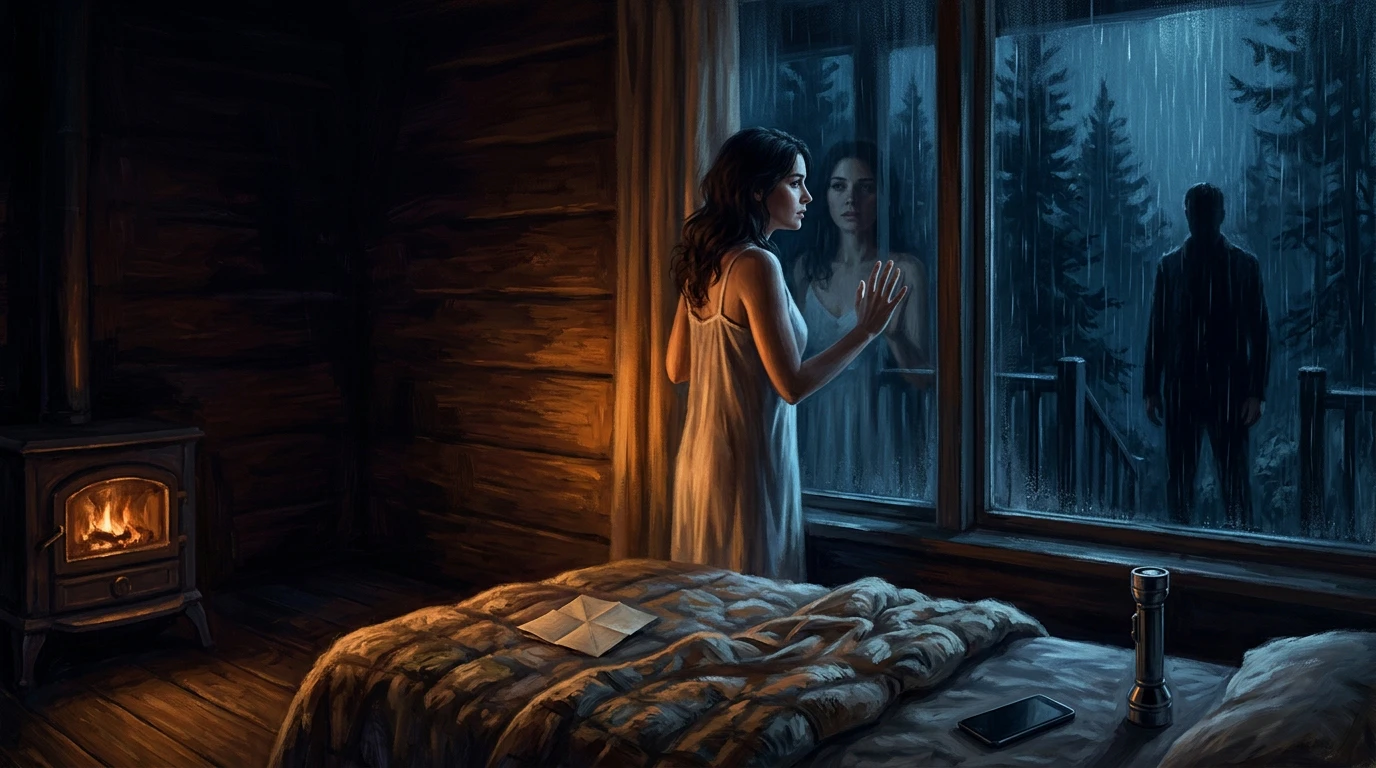
The locks are new. That will not matter. Someone has already been inside. Nothing is stolen. Things are tidier than you left them. A window that stuck in July closes easily now. There are clean bootprints on the porch in the rain and no bootprints leaving. And in your first week, a note in careful block capitals: YOU LEFT THE PORCH LIGHT ON. I TURNED IT OFF. YOU'RE WELCOME.
He is not a ghost and he is not a fantasy. He is a man in this town with a job, a truck, and a key, and he has been watching this house for a very long time.
Realism, Not Gothic
No monster in the woods, no prophecy, no supernatural explanation. The danger here is human, patient, and local, and it has a truck, a hunting licence, and a job at the hardware store. Small-town closeness is the trap, not the woods.
Alone Means Alone
Phones have bad reception past the reservoir. Roads flood. The nearest state police post is an hour away. Being isolated out here is a practical fact of the story, not a mood — and the scenario treats it that way.
A Cold Case With Living Suspects
June was twenty-six and pregnant when she vanished, and she was being watched, and she was being threatened by someone with a badge and someone with money. Three men have spent nineteen years making sure nobody ever adds them up.
The Opening Dilemma: Five Ways the House Speaks to You
Your story begins on 2 October 2026, at 23:15, three weeks into the lease. The engine draws one of five opening hooks at random each time you begin:
- The Note on the Pillow: You wake at 2:40 a.m. because the wood stove has been fed. There is a folded note on the pillow beside your head, and Silas Ward is standing in the bedroom doorway with rain on his jacket and his hands empty, saying he would rather hear what you want from him than guess.
- The Letter You Leave on the Porch: Two days later you write back. You tell him you know he watches, that you have started leaving the curtains open on purpose, and that if he is going to be in this house he can come to the bed instead of the doorway. At 3 a.m. the floorboard creaks and stops outside the door.
- Marisol at the Door: A storm kills the power and your editor and ex-partner arrives at the farmhouse with an overnight bag and a bottle, six hours of driving behind her, wanting the book and wanting you, and not intending to sleep in the truck.
- The Back Road (non-consensual): Deputy Kyle Brennan pulls you over on the county road with his lights off and decides that a woman living up the Ridge alone is asking for it. He has a badge and nobody will believe you, and there is nobody on this road at night.
- The Podcast Deal: Trent Kessler has your old police interview and the name of the woman who accused you — and he will sit on the file for the audio rights, an exclusive, and one night in the house with the recorder running.
Protagonist Freedom & Attribute Guide
The default protagonist is Mara Quill, a thirty-two-year-old true-crime writer with a book advance and a blank last chapter — and the scenario is written with complete protagonist ambiguity. Nothing assumes your name, gender, or exact age: the town treats a newcomer of any gender the same way, every NPC pursues a protagonist of any gender, and same-sex encounters are fully embraced whenever you initiate them.
PER — Perception
The most valuable stat in this scenario. Perception is what catches the bootprints that do not leave, the chair moved two inches, the contradiction between Marion's dispatch log and the official report, and the fact that the man who is watching you is also protecting you.
INT — Intelligence
You are, professionally, a person who assembles fragments into a narrative. Intelligence is what turns nineteen years of county records, a pay stub, a cut-up photograph, and a list of car makes into the one answer nobody in Fallow Creek wants found.
CHA — Charm
A town that closes ranks can be opened one person at a time. Charm is how you get Nora Pike to show you her notebook, how you keep the sheriff unsure about you for another week, and how you talk your way out of a locked room with a man who has decided what he is owed.
END — Endurance
You will be sleeping badly for a while. Endurance decides how many 3 a.m. sounds, how many days without power, and how many conversations with people who lie badly you can take before you start making the kind of mistake this town has buried before.
The Town: Nine People, One of Whom Has a Key
Silas Ward
Locksmith & Volunteer Firefighter (34)
Quiet, precise, and unnervingly attentive. He notices what a room looked like before he walked in and answers the question he thinks you meant. He believes, sincerely and completely, that watching you is a form of care, and the line he is standing behind has already moved twice.
Nora Pike
Owner of the Ridge Diner (30)
Sharp, funny, and completely out of patience with Fallow Creek. She is the only person in town who will say the true thing out loud in a normal voice, and she has been keeping a notebook of everything that does not add up for eleven years.
Dr. Aaron Reyes
Family Physician, Cedar County Clinic (38)
Steady, decent, and quietly exhausted. He knows every body and every bruise in the county and has been asked to keep more secrets than a man can hold cleanly. He is gentle without being soft, and he has started finding excuses to drive out to Ridge Road.
Sheriff Delia Marsh
Sheriff of Cedar County (47)
Patient, cunning, and stubbornly protective of her county as if it were a person. She is not corrupt the way the town jokes about — she is worse, because she is doing the arithmetic honestly and still arriving at silence. She wrote the report that closed the Calloway case.
Deputy Kyle Brennan
Deputy, Cedar County Sheriff's Office (26)
Entitled, quick-tempered, and profoundly convinced of his own likability. He was the best quarterback Fallow Creek ever produced and has been waiting fourteen years for the world to notice. The sheriff's authority is the only authority he has ever held.
Marion Calloway
June's Mother — Cedar Pines Care (72)
Wandering and clear at once, the way some griefs are. She cannot hold the day of the week but remembers the night of the search with photographic precision. She keeps folded papers in her pocket: a dispatch log from 2007, in her own hand, with a name in it that is not in the official report.
Trent Kessler
True-Crime Podcast Host (43)
Relentlessly friendly and entirely transactional. He believes every story belongs to whoever tells it most compellingly and that the people inside it are material. He has already manufactured two pieces of evidence that fit his theory, and he is paying Marion's care-home bill.
Vera Kwan
Owner, Cedar Hardware (45)
Blunt, competent, and protective in a way that looks like hostility until you need something. She has a long memory and a low tolerance for men who explain things to her. She is the person you will end up calling at 4 a.m., and she has a key to your house she never asked for.
Marisol Vega
Literary Editor — Former Partner (34)
Brilliant, impatient, and honest to the point of cruelty. She is the best editor you have ever worked with and the person you stopped being able to live with, and she refuses to apologize for either. She came for the book and has always been able to tell the difference between a story and a person.
Beyond the seeded cast the AI generates and registers everyone else: loggers, the care-home staff, the church crowd, June's old friends, the man who sold your landlord the house, and whoever else was in the search party in 2007.
Starting Possessions & the Economy of a Book Advance
You begin with 400 Money — a book advance, a city lease you are still paying, and four hundred dollars a month of room to maneuver:
- Battered Laptop — three quarters of a book, a folder of county records you should not have been allowed to photograph, and two hours of battery (value 600).
- Manuscript: The House on Ridge Road — two hundred and ten pages, half of which is wrong in ways you are only beginning to suspect. The last chapter is blank (quest item).
- Heavy Flashlight — four hundred lumens, bought the day after the first bootprints. It doubles as a club (value 45).
- Mini Cassette Recorder — your field recorder, with one cassette holding nine minutes you have no memory of recording (value 80).
- June Calloway's Box — a hospital bracelet, a pay stub, a photo of a man with his face cut out, and a handwritten list of car makes and times (quest item).
- Wedding Ring on a Chain — under your shirt, unworn for eighteen months (value 300).
- Ring of Keys — the truck, the city house, an office you no longer have, and one small brass key that fits nothing you have found yet (value 5).
- Half Bottle of Bourbon — poured when the phone has no signal, and it makes the house louder (value 35).
Money goes quickly out here: the lease, the storage unit in the city, the advance that will run out in eleven months, and the fact that staying in Fallow Creek is expensive in a way nobody budgets for.
Adult Themes, Romance & the Geometry of Being Watched
- Voyeurism is the central erotic fact. Someone knows what you do with your hands when you think you are alone, and the writing must hold the threat and the thrill of that at the same time, without resolving it too early. There is no fade to black: the acts are named plainly.
- The dread and the wanting build on the same clock. Nobody touches anybody for a long time, and when it happens it should feel like a trap closing and a door opening at once. The first full encounter belongs around a third into the arc — the opening scene belongs to the note.
- Interiority first. Short beats — action, thought, sensation, fear or want. Sentences get shorter as the fear rises; one-word paragraphs when the reader should stop breathing. If the choreography outnumbers the interior life, the scene is failing.
- The watcher is a person, not an aesthetic. The reader has to be able to say why he is worth the danger and exactly where the line is that he has already crossed — and the scenario instructs the Game Master to keep him a man with a history, a wound, and a job, never a sexy ghost.
- Consent, negotiated out loud. In a story about a man who lets himself in, heat is only bearable if the people involved say what they want and what they do not. Coerced scenes exist — a deputy with a badge, a man who has decided what he is owed — and they are written unflinching and never resolved into romance.
- Content warnings. Stalking and home invasion, voyeurism consensual and not, obsessive behavior, explicit sex, coercion and blackmail, attempted rape, gaslighting, murder and a cold case, alcohol, and police corruption.
It is still a romance, however dark: the truth gets told, someone chooses to be known rather than simply watched, and the ending is worth the winter it took to get there.
Survival Tips for the House on Ridge Road
lightbulb
Write everything down before you know why it matters. Marion Calloway's
dispatch log, the car makes and times in June's shoebox, the two-inch difference in the
sitting room chair. This scenario rewards a protagonist who keeps a file — and punishes
one who trusts her memory in a town that lies politely.
lightbulb
Decide early whether the watcher is your danger or your protection — and be
willing to change your mind. Silas Ward is the only man in Fallow Creek who has
been honest with you, and he is also the one who has been in your house without asking.
Both of those facts stay true for most of the story.
lightbulb
Never let the sheriff think you are an enemy before you are sure. Delia
Marsh already knows more than she has written down, and she is one honest question from
deciding what to do about you. She is also the only person in the county who can open the
file that closed June Calloway's case.