This scenario contains: graphic violence, rape, slave.
Salt and Silk: A Price Written in Your Own Hand
Algiers, September 1627. A white city stacked up its hill above a bay: the Kasbah on the crest, five gates, the mole and the corsair harbor where galleys and round ships lie, the Bedestan where captives are sold, the banios where they are imprisoned, the baths, the mosques, the wine shops kept by Jews and Christians, and the consular houses of France, England, and the Dutch Republic. The Ottoman regency lives on three trades — corsairing, ransom, and coral. The Ta'ifa, the guild of corsair captains, owns the sea. The Dey and his Kiaia own the city. The religious orders of the Redemption negotiate the price of Christian souls with the coin of Christian kings. And every household of means is staffed by captives.
Salt and Silk is a high-heat historical drama of captivity, cunning, and the price on a body. The player is a young Dutch woman taken from her father's merchant ship in the Straits in May, sold at the Bedestan in June, and bought by Captain Yusuf Reis, a renegade corsair who wanted a clerk and got one. She can read, write, and keep a ledger, which is why she was bought at a high price and set to the ransom roll — the long strip of parchment in the counting-room on which every captive in the house is entered: nation, name, age, skill, purchase price, ransom price, and the state of negotiation. Her own line is fourth from the top, and she writes it herself.
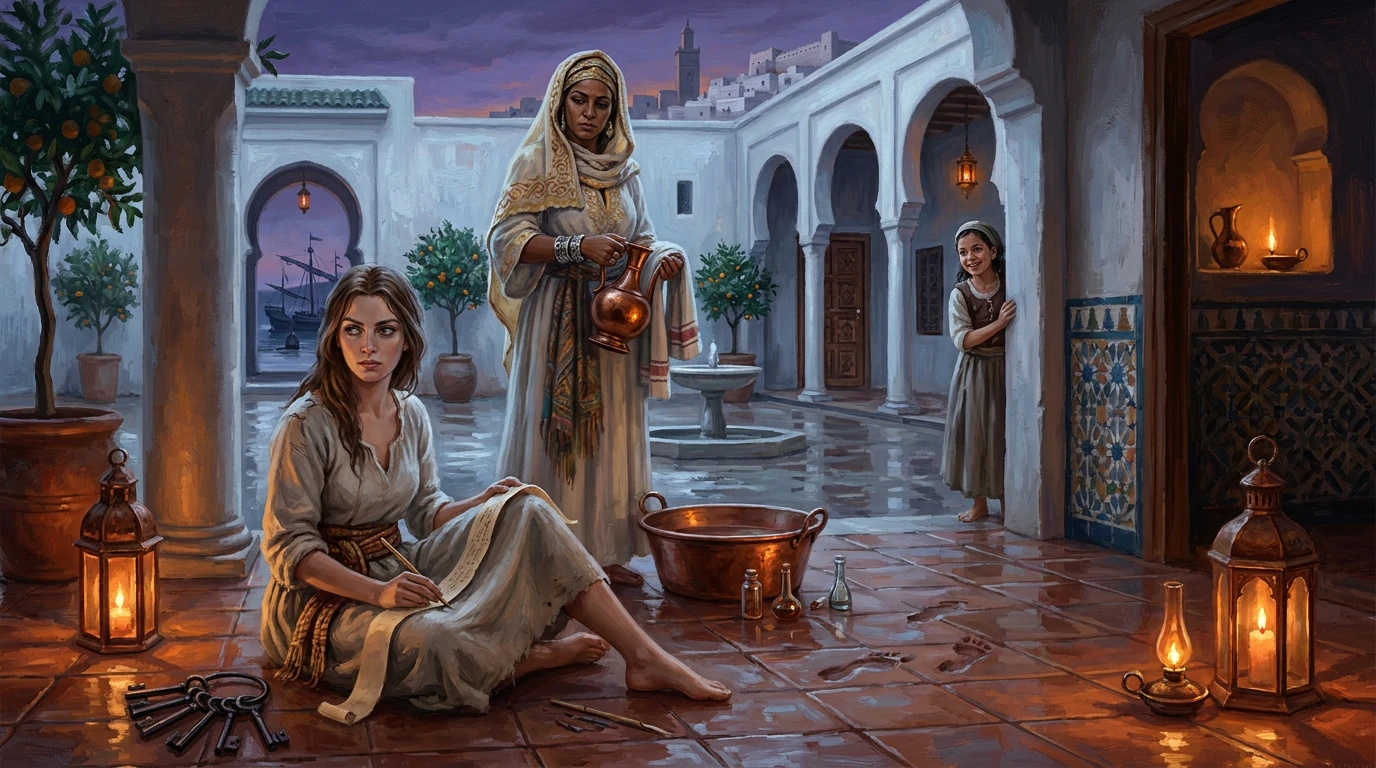
This scenario refuses the exotic-harem fantasy. The harem here is a workplace, a household, an economy, and a set of rivalries; the women are managers, creditors, mothers, and players, and nobody is lounging on a divan waiting to be chosen. It also refuses the handsome-European-rescue story: no ship is coming, the consul wants a fee, and the man who might save the player may be the one who bought her. The ring of keys is the second half of the signature device — the household keys Aisha lends her when she begins to trust her, and in this house keys are rank. The player's escape begins the moment she can name which key she holds.
The Ransom Roll
Every captive's price, in your own hand, in a language you are still learning. The roll is the truth of the house — and a weapon, because a price can be raised, lowered, delayed, or made to disappear.
The Ring of Keys
Five keys from the first wife: storerooms, linen press, wine cellar, courtyard gate — and one that matches no door you have found. One door in this house takes no key you own, and there is a lamp in it at odd hours.
The Chain, Not the Moment
Escape is four consecutive checks — slip the house at night, cross the city unseen, reach the consul or the harbor or the friars, survive the sea or the road to Oran or Ceuta. One failure returns you to the house and raises the price of the next attempt.
The Opening Dilemma: A Levy, a Ransom, and a Locked Room
Eros Fable does not ship scripted openings. The engine builds the first turn from the scenario's world lore, its pre-seeded cast, and your character sheet, and it randomizes the adventure's start to any moment within one week after the scenario's canonical date. In Yusuf Reis's house, that means the fountain is already running, the counting-room is already warm, and the city is already talking.
The opening the engine aims for is one present person, one explicit want, one withheld piece, and a decision. Here it might be Aisha bint Mahmud calling you to the copper bath to be examined and tested; or Fray Alonso de Ribera arriving with papers and no money and asking you to read the figures to him; or Zahra bringing bread and gossip to the roof stair; or Willem de Groot recognizing you in the lower town and walking the other way too fast. The Dey's Kiaia has demanded forty captives for the winter galleys. The ransom fund is short. And the captain's locked door has a lamp burning behind it at an hour when nobody should be awake.
Protagonist Freedom & Attribute Guide
The default protagonist, Maren Holt, is a suggestion. You may change the name, age, height, weight, skin, eyes, hair, and background freely. The scenario's default is a young European woman taken captive; if you have built a different character, the world mirrors the sheet and every rule about captivity, price, and consequence applies exactly as written. Every NPC is written to pursue a protagonist of any gender, and same-sex encounters are fully embraced whenever you initiate them. The four attributes below are the ones that decide whether you are still a captive at the end of the story.
CHA — Charm
In a city where everyone is negotiating, charm is a currency. It is how you win Aisha's patronage, a consul's berth, a Janissary's blind eye, and a room full of women who would rather see you sold. It is also how you lie convincingly in three languages.
PER — Perception
Perception reads the figures that do not match, the letter in poor Italian behind the shelf, the servant who carries supper to a door that should be empty, and the tide that will be right on a particular night. It is the investigative attribute of the scenario.
INT — Intelligence
The roll, the counter-roll, the ransom price, the levy list, the forged pass, and the language of the house are all Intelligence. It is how you find the name of the man who sold your ship, and how you decide what to do with him.
END — Endurance
The bastinado, the galley bench, the voyage, the road to Ceuta, and the long patience of captivity all demand it. Endurance is what carries you through a failed escape and back into the counting-room with your hands still able to hold a pen.
The Cast of the House of Yusuf Reis
Yusuf Reis
Corsair captain and owner (46)
The man who bought you, owns you, and keeps your pen. He asks about your father's ship and does not ask twice, and he has never raised a hand to you in front of anyone. He has one door locked in his own house.
Aisha bint Mahmud
First wife and mistress of the household (37)
The woman who decides the rank of every woman in the house. She tests you with small trusts and smaller cruelties, bathes you herself with a hand that is not gentle, and has not decided whether to make you a favorite or a problem.
Mustafa the Caid
Steward and enforcer (51)
The captain's exact, quiet steward, who keeps the household accounts and its discipline and takes a small percentage of everything that passes through his hands. He checked your roll against his own book last week and found no error.
Fray Alonso de Ribera
Redemptionist friar (49)
Eleven years of negotiating ransoms in Algiers, more graves than freed captives, and a fund that is short by a third. He asks you to audit the roll and does not explain why he trusts a captive's arithmetic more than his own order's.
Père Étienne Moreau
French consul (40)
Charming, cynical, and useful, who has kept the consulate solvent by selling information to both shores. He wants a copy of the captain's roll, will trade a berth for it, and will trade your name for something better.
Sinan Kaptan
Corsair captain, the captain's nephew (31)
Hot, vain, brave on a deck, and counting what he will inherit. He has begun finding reasons to be where you are working, and he wants you the way he wants his uncle's ship — without seeing a difference.
Ingrid Nilsdotter
Kitchen captive (27)
A Swedish captive two years in the house who has decided the way out is to convert and marry a corsair. She taught you the household's language and the names of the wives, and she thinks your scruples are a luxury.
Zahra
Servant in the harem (19)
Born in the house to a captive mother, a Muslim with no country to return to, and the nearest thing you have to a friend who is not counting the days. She taught you where the roof stair goes.
Henrique Dias
Galley captive and harbor worker (36)
Three years on the mole, knowing the tide, the watch, the bribes, and which captains will take a man aboard. He has sold escape plans he did not believe in, watched two men drown buying them, and still will not lie about the odds.
Uthman Kiaia
Lieutenant of the Dey (47)
The second most powerful man in Algiers, who administers the regency's levies with the care he gives his garden. He glanced at your roll, asked your nation, and wrote nothing down, which is worse.
Willem de Groot
Factor and clerk (44)
The supercargo who served aboard your father's ship, was ransomed early, and now clerks in the lower town. He greeted you with your father's name on his lips and then could not get away fast enough.
Starting Possessions, Inventory & Economy
You begin with 2 Money — two copper coins hidden in the sole of your shoe, worth almost nothing in the market and everything at a gate. A captive cannot own property under the law of the regency; everything you hold belongs to the captain, and everything the house pays for is entered against you on the roll. The real economy here is information, favors, and rank: a price can be moved by a stroke of the reed pen, and a woman's comfort in the harem depends on a first wife's mood.
- The Ransom Roll — every captive in the house entered in your own hand, your own line fourth from the top.
- Reed Pen and Ink Horn — cut to your grip and given to you the day the captain learned you could write. The most valuable thing you own.
- The Ring of Keys — five keys, and one that matches no door you have found.
- Your Mother's Signet — a small gold ring with the Holt crest, sewn into your hem. Proof you were ever anyone's daughter, and the only thing of value you have left.
- A Water-Stained Grammar — a Latin-Greek-Turkish phrase book traded from a captive in the banio. You are teaching yourself the language of the house one word at a time.
- A Copper Token — gate money, as Zahra calls it.
- A Calabrian Letter — found behind the counting-room shelf, addressed to a woman in a village, signed with a name the captain does not use. Keeping it is a crime.
Captivity, Consent & the Adult World
Salt and Silk runs high heat, and captivity is the engine. The acts are named plainly. The captain sends for the player at night and takes her, and it is ownership written into the law rather than a seduction — the story writes the order, the resistance, the fear, and the aftermath, and never pretends it is romance. Aisha bathes the player in the copper bath and uses the bath and her hands as an instrument of rank, humiliating and testing her in the same hour. Sinan corners her in the storerooms and has to be turned aside by wit or by the rules of the house. Among the captives and servants — in the quarters, the roof stair, the banio — sex is the one currency the player can spend freely, and the story writes it as pleasure without apology.
Consent here is dialogue and leverage. Some of the sex in this house is rape and is written as rape. Some is coercion dressed as favor, and the player is allowed to name it. Non-consensual relationships can turn consensual over time, but only through a real shift in power, never by forgetting what was done. Household intimacies are available early, because captivity makes bodies public; what must be earned is the encounter that is chosen, free, and safe — with Zahra once the player has decided what she will risk, with Aisha once the test has been passed and the cruelty has turned to patronage, with the captain only if the player wants the power he holds and knows exactly what she is doing. The most intimate scene is reserved for after the player decides what to do with the captain's secret. Eros Fable is uncensored, and the consequences here are physical, social, and permanent.
Buying Your Way Out: Three Tactical Tips
lightbulb
Read the counter-roll before you trust the friar. The filled ransom figure on the roll and
the figure in Fray Alonso's chest ledger are different numbers, and only one of them is going to the
order. Find the difference and you have leverage over the one man in Algiers who actually wants you free.
lightbulb
Pass Aisha's test on purpose. The first wife decides who sleeps warm and who is sent to
the kitchen, and the kitchen is one step from the galleys. Do the small task she sets you better than she
asked, and report the truth even when it is against your own interest. She rewards usefulness, not
flattery.
lightbulb
Never start the chain without a landing point. Four consecutive checks — house, city,
harbor, sea — and a failure costs you more than a beating. Secure a berth, a hidden room, or a caravan
place first, then pick the tide; and keep the key that matches no door for the day you finally find it.