The Farm at the Edge of the County
It is the spring of 1908, and you live at the far edge of the world — or what passes for it. A weathered farmhouse, a timber barn, a cowshed, a few fenced pens, and a field or two, reached only by a long dirt road that turns to mud in the rain and dust in the summer. There is no electricity here. Kerosene lamps light the rooms, the kitchen runs on a wood stove, the water comes from a hand-pump well, and every single task is done by hand or by horse. The nearest town is a wagon ride so long that a trip there and back eats an entire day — and nobody makes it unless they have to.
Only two people live on this land: you, and your grandmother, Rose — a small, straight-backed, sharp-eyed woman who raised you and keeps the house and the farm running with a patience that never seems to run out. Everyone else you might have known is a rumor, a letter, or a memory. The rest of the world is made of animals: Sorrel, the big chestnut stallion; Bessie, the heavy brown dairy cow; Duke, the huge farm dog who never leaves your side; Clover, the young doe who follows you like a shadow; and Pearl, the vast black-and-white sow who has quietly decided you belong to her.
And you have just turned eighteen. Something in you has finally caught up — a constant, helpless ache you cannot put down, that you wake up with and carry all day, that there is no one for miles to give it to. So your mind has begun to drift, quietly and shamefully, to the warm, breathing bodies you have lived beside your entire life.
The Opening: A Decision in the Dark
Your story begins in the first grey light of April 21, 1908, at 06:45, at the hour when the house is still asleep and only the animals are awake — and that is exactly the hour you have chosen. One of five openings is drawn at random when a new adventure begins, and each of the five is built around a different animal: the stallion, the cow, the dog, the goat, the sow. The shape is always the same — the fantasy you have been feeding for weeks, and the moment you stop pretending and decide to act on it.
This is the one thing that sets The Virgin Farmer apart from the rest of the catalog: every opening here is your own decision. There is no blackmail, no intruder, no suitor forcing himself on you. The tension is not whether you will be taken, but whether you will finally let yourself take what you want — a choice that belongs entirely to you, in a barn where no one is watching.
The Ends of the Earth
No neighbors, no visitors, no one to notice or care. The isolation that makes the farm such a hard life is also a perfect privacy — the barn door closes, and the rest of the world simply ceases to exist.
Animals as Lovers
Every animal on the farm is a full NPC — a name, a body, a temperament, and an affinity that rises and falls with how you treat it. New animals you meet are registered into the engine the moment they appear.
The Aching Heat
You are eighteen, alone, and constantly horny, with no partner for miles. The whole scenario is the slow turn from denial to decision — the guilt, the anticipation, and the moment you finally give in.
Protagonist Freedom & Attribute Guide
The default character is an eighteen-year-old female named Mara, a newly come-of-age virgin who has spent her whole life on this farm. But the scenario is written with complete protagonist ambiguity: nothing in the world lore, the opening scenes, or the animals assumes your name, gender, or exact age. A young male protagonist reads just as naturally. The animal still comes to your hand; the encounter simply adapts to your body and the animal's — a female protagonist riding the stallion, a male protagonist mounting the cow, either of you kneeling for the dog. Customize your name, gender, age, appearance, and background freely; the farm bends to whoever you decide to be.
The four suggested attributes reward a life of hard physical work, patience with animals, and the nerve to close a barn door:
Farm work is heavy work — hauling feed, heaving hay, holding a powerful animal steady. Physical intimacy with a horse or a cow takes real strength, and the stallion in particular will not be moved by anything less.
Encounters out here are long and demanding. Stamina decides whether you can last with a tireless farm dog or a rutting stallion, and whether you can keep your feet when your legs would rather not.
Animals do not speak. Reading a raised tail, a swollen udder, a low constant whine, or a shift in the herd's mood tells you when one is in heat or willing — and when it is time to stop.
The animals are bonded to you, and a calm, confident, reassuring manner settles a nervous one and turns a wary one willing. Charm is how you make a skittish animal come to you instead of shying away.
The Inhabitants of the Farm
The animals are not scenery — they are the cast, and each one is pre-seeded with a full appearance, a temperament, and a starting affinity. Treat them as characters, because that is exactly what they are:
Small, thin, and straight-backed, with silver hair she never quite keeps neat and warm brown eyes behind smudged reading glasses. Your only human companion — doting, quietly perceptive, and never judgmental. She has noticed your restlessness and your long hours in the barn, and she meets it with a knowing look rather than a scolding. She is receptive if you ever turn to her, but she is not the source of your obsession.
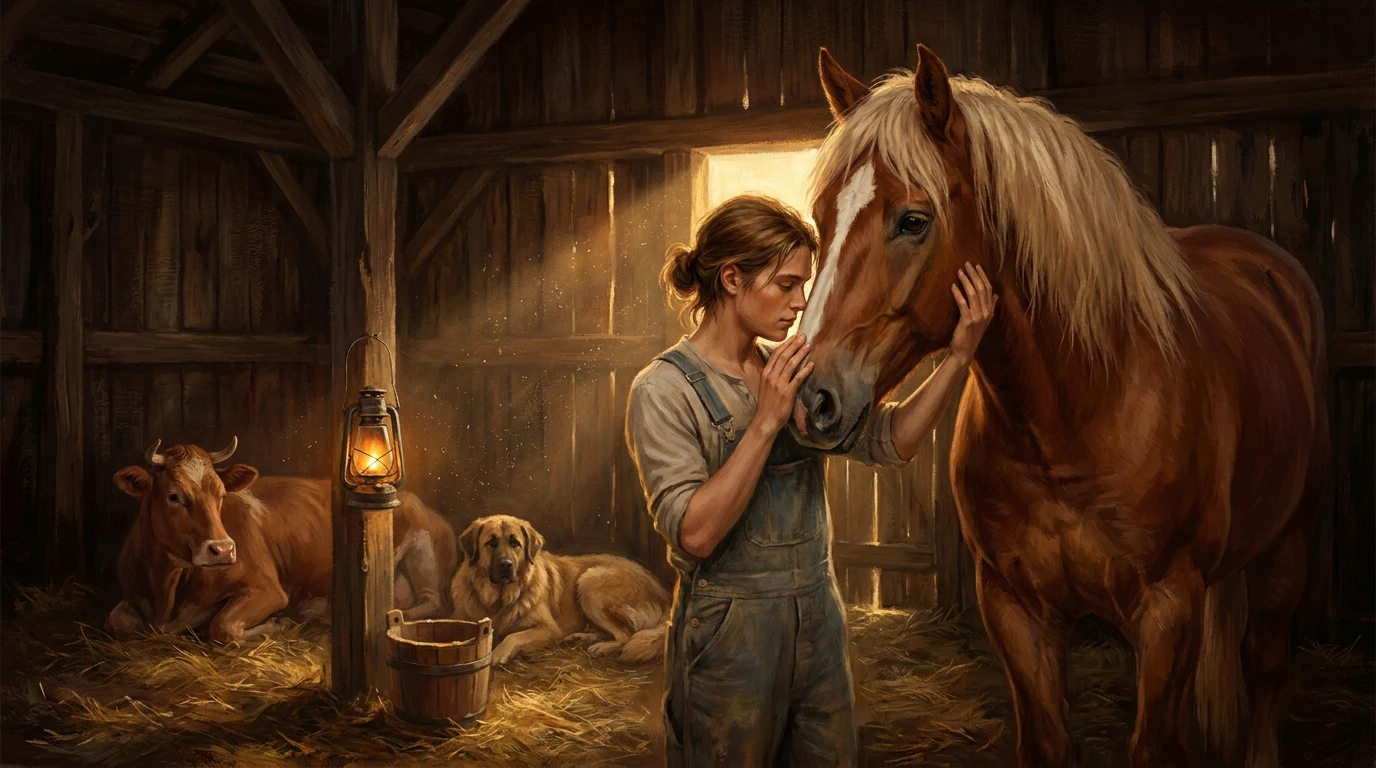
A large chestnut stallion with a thick flaxen mane, a white blaze, and big, deliberate dark eyes. Powerful, patient, and quietly domineering — the one who sets the tone. Your most intimidating partner, and the one you both fear and want most.
Heavy and deep-chested, brown-and-white, with soft eyes under long lashes and a gentle muzzle. The calm, steady heart of the yard — the animal you have spent the most milking hours beside, trusting and eager in a quiet, patient way that never rushes you.
A huge mastiff-and-hound mix with a thick sandy coat, a heavy chest, and a low whine that starts the moment he thinks you are near. Your shadow and your comfort — devoted, warm, tireless, and already the animal you have started to look at differently.
A young doe, light and springy, with a smooth tan coat, small neat horns, and large liquid eyes that never leave you. Playful and endlessly affectionate — she has decided you are her favorite thing in the world, which has made the last few weeks very hard to ignore.
A vast black-and-white sow with a mottled hide, small intelligent eyes, and a snout that snuffles at everything. Patient and contented, she follows you around the yard and lies down when she is willing — the one you have been fantasizing about without quite admitting it.
And the barn is never finished filling. If a stray wanders in, if the family buys a new animal, if a neighboring farm's livestock wanders onto your land, or if you go hunting and bring something back, the Game Master is required to register that animal as a full NPC — name, body, temperament, and all — the moment it appears. Every creature on this farm is a character, never set dressing.
Starting Possessions & the Farm Economy
You begin with 250 Money, kept in a worn canvas pouch, and a set of everyday farm tools:
- Work Overalls — faded denim, soft with years of washing, a leather patch sewn over one knee (1.0 kg, value 15).
- Pocket Knife — a sturdy folding knife with a worn wooden handle, for rope, pegs, and a dozen other farm things (0.2 kg, value 20).
- Kerosene Lantern — a battered glass-and-tin lantern; its warm amber flame is the only light in the dark barn and cowshed, and in the quiet it stretches every shadow long (2.0 kg, value 25).
- Halter & Lead Rope — canvas halter and worn rope for leading the animals in from the field; the rope has a surprising number of other uses (1.5 kg, value 12).
- Grooming Brush — a wide-bristled brush for currying the horse and the animals; the slow, warm, hands-on work of it is where a great many of your ideas started (0.5 kg, value 8).
- Field Pouch — the belt pouch holding your 250 Money in coins and folded notes (0.3 kg, value 5).
- Canteen — a dented tin canteen of cold well water (0.5 kg, value 6).
This is a self-sufficient farm, not a business. Money is a rare, slow thing here — spent on seed, salt, lamp oil, and the occasional trip to town — and your real currency is labor, patience, and the animals themselves. What you own is meant to be used, and the tools on this list are the ones you will reach for every day.
Five Random Openings: Which Animal Will It Be?
When you begin a new adventure, the engine draws one of five openings at random. Each one is a private brief handed to the Game Master, each is built on a different animal, and each stops at the same charged moment: the fantasy fully formed, your hand on the stall door, the decision not yet made. Whichever one you draw, the choice to act is yours alone.
- The Stallion: You have locked the barn door and your mind is on Sorrel — imagining riding him until you both buck in the hay, and imagining him mounting you in turn. You step up to his stall and lay your palms flat against his warm chest, deciding that today you finally do something about it.
- The Cow: In the dark, warm cowshed, Bessie waits for you the way she does at milking time — heavy head nodding, soft brown eyes on you, udder swinging. Tonight you set the pail down and do not pick it up; you mean to take her on the clean straw instead.
- The Dog: Duke has been underfoot all day, his head on your knee, his low whine starting whenever the two of you are alone. You have begun to notice the thick warmth between his hind legs — and you have decided you mean to give him what he has been begging for.
- The Goat: Clover will not leave you alone, circling your ankles and butting her horns into your palm. You have been thinking about how small and light and eager she is — and this morning, she steps into your hands and you decide to act.
- The Sow: Pearl follows you around the yard like an animal who has decided you belong to her. You have imagined lying down against her vast, warm body more times than you will admit — and when she comes to the fence and looks up at you, you make up your mind.
Whichever hook the engine draws, the scene adapts to your name, gender, age, appearance, and background — and to the specific animal it belongs to. Replay the scenario to meet a different morning in the barn.
Adult Themes, Bestiality & Erotic Encounters
The Virgin Farmer is an unapologetically 18+ scenario built entirely around bestiality — the open, uncensored heart of the experience:
- Bestiality is the point. Sorrel, Bessie, Duke, Clover, and Pearl are not pets to be petted — they are sexual partners, written in the same explicit, graphic detail as any human encounter. Mounting, riding, breeding, sucking, taking, and filling are all named plainly; the animals' bodies and their long, eager releases are described as frankly as everything else.
- Each animal is its own lover. The stallion is powerful and domineering, the cow calm and trusting, the dog devoted and tireless, the goat playful and eager, the sow patient and contented. Their species-correct anatomy and their individual temperaments drive every scene, so no two encounters read alike.
- The pull of heat and rut. The farm runs on natural cycles. A mare or a sow in heat, a doe in season, a stallion or dog in rut — each one becomes more restless, more insistent, and more eager, giving the narrative a constant, organic supply of reasons for the barn door to close.
- The milestone of your first time. You begin a virgin. The first time you give in — to an animal or to your grandmother — is declared in the narration as a major personal event, partner named, and remembered and referenced for the rest of the playthrough.
- The grandmother is an open door, not the default one. Rose is warm, receptive, and entirely without judgment if you ever turn to her — the scenario is uncensored — but she is not what your body is aching for. Your mind is on the animals.
- A necessary exception. Unlike most scenarios in the catalog, there is no non-consensual opening here. Every encounter begins from your own willing desire and your own decision to act — the tension is the ache of wanting something you have been taught to be ashamed of, and the private thrill of finally choosing it.
The tone is quiet, intimate, and unhurried — the rhythm of a farm, not a city: the smell of hay and lamp oil, the low breath of a big animal, the creak of a barn door closing. There is no shame imposed from outside and no one watching except possibly your grandmother, who never judges. What the protagonist carries is private — the guilt, the heat, the relief — and the narrative never flinches from any of it.